

We all use ChatGPT — it can draft a Shakespearean sonnet about your Q4 pipeline in seconds. But will it actually help you hit your goals?
In the rush to adopt AI, many marketing organizations lean on generic tools that deliver good demos but fail to drive measurable business outcomes — or require technical teams to make them usable.
The issue isn’t the technology itself — it’s the gap between AI’s broad capabilities and your organization’s specific customer data, workflows, and growth objectives.
AI without business context is not a strategy. And if it isn’t accessible to the people running campaigns, marketers will keep defaulting to generic tools that weren’t built for business growth.
Why Generic AI Doesn’t Move the Needle
Most generative AI solutions are built for general-purpose use. They can draft content, answer questions, and spark ideas — but they don’t inherently understand your customers, your data, or your market. And without an easy way for marketers to connect AI to their daily workflows, these tools rarely make it out of the brainstorming phase.
Imagine giving ChatGPT a list of your top 1,000 customers — names, purchase history, churn signals — and asking for next-best actions. Beyond the privacy and compliance concerns, the output would be unreliable, disconnected from your marketing stack, and impossible to act on without significant technical effort.


Your Data Is the Real AI Power Source
AI delivers value only when fueled by connected, high-quality, governed data — and it must also be accessible to the marketers making real-time decisions. Otherwise, AI remains a technical exercise that never translates into usable campaigns.
Marketing AI and the Evolution of the CDP: From Repository to Intelligence Engine
AI models need real-time, high-quality customer data to deliver true impact. CDPs have long promised this, but leading platforms are evolving beyond storage into marketing intelligence centers — making customer intelligence both comprehensive and marketer-friendly.
Modern Marketing AI should:
- Integrate all customer data — behavioral, profile, structured, and unstructured — into a governed source of truth marketers can actually use.
- Ensure outputs are relevant, actionable, and tied to KPIs — in a format business users can execute.
- Power intelligent agents that can decide, act, and learn across marketing, sales, and service functions without requiring technical mediation.
Those needs require a foundation to connect each element of data to the customer journey. That means composable.
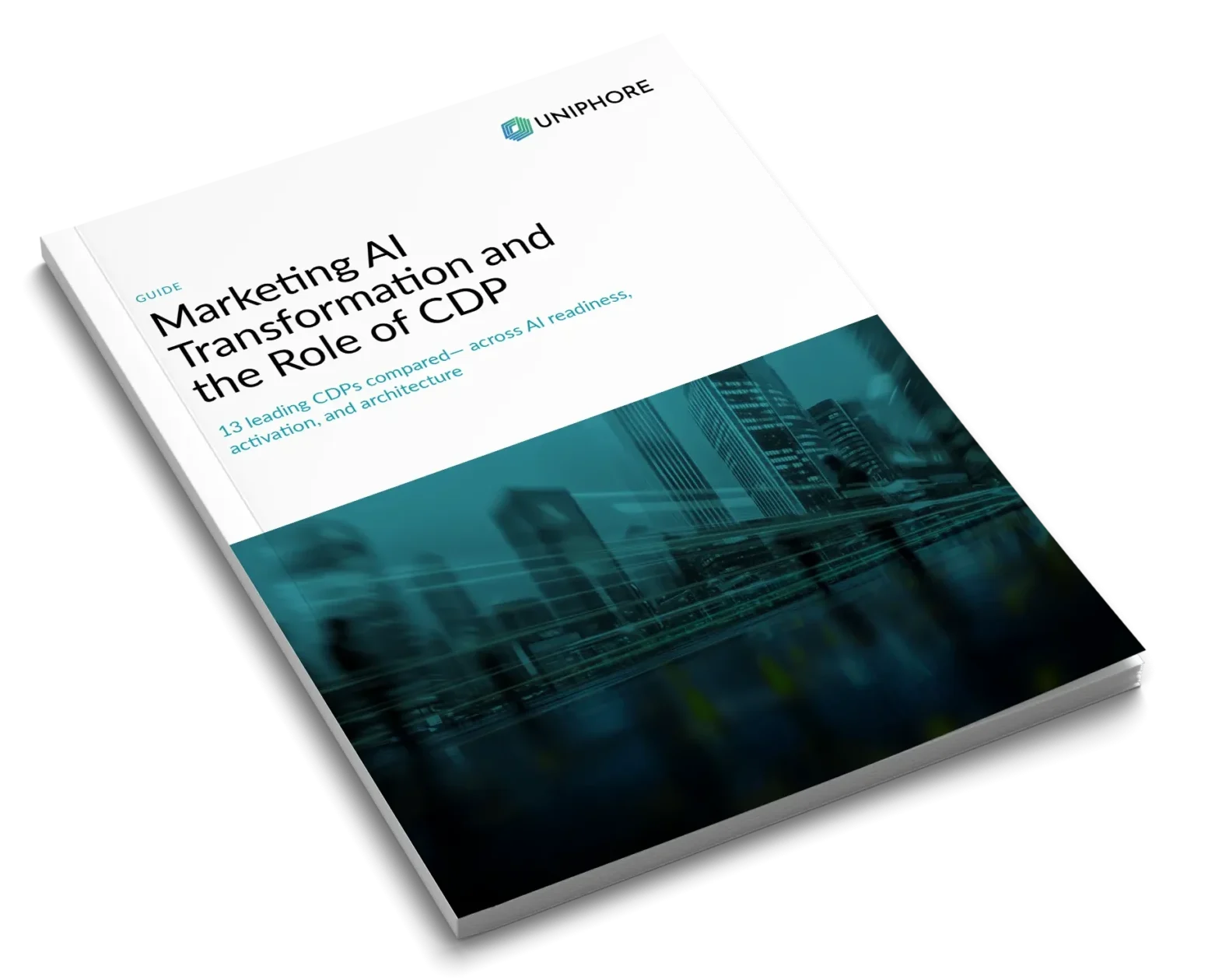
Marketing AI Transformation and the Role of CDP
13 leading CDPs compared — across AI readiness, activation, and architecture
Why Composability Is the Key
The pace of AI innovation demands flexibility, but composability is about more than plugging in the latest model. A composable infrastructure ensures that every new AI capability is grounded in the full context of your customer data — and delivered in a way that marketers can act on immediately.
With a composable foundation, marketing teams can:
- Unify the full context of data across systems — and put it in marketers’ hands.
- Fuel precise decision-making by connecting AI outputs directly to customer history, preferences, and intent.
- Orchestrate marketing activities seamlessly — from segmentation to activation — through intuitive interfaces that reduce reliance on technical teams.
- Stay agile with innovation by integrating emerging AI tools and agents without costly overhauls or complex retraining.
Composable isn’t just a technology choice — it’s the bridge between raw data and intelligent, marketer-driven action. By giving AI both the rich context of customer data and a business-friendly interface, composable Marketing AI transform AI from generic idea-generation into a true driver of growth.
Marketing AI in Action With Skechers
Skechers knew personalization was the key to deeper customer connections. To make it happen, the brand brought together the Uniphore Marketing AI Customer Data Platform and the Databricks Data Intelligence Platform—using AI to unify global data, generate real-time insights, and give marketers the power to act fast.
The results speak for themselves:
- 324% increase in click-through rate
- 68% decrease in cost per click
- 28% boost in return on ad spend
- Campaign lead time cut from 2-8 weeks to 4-10 days
With AI-driven segmentation and predictive insights, Skechers can now identify at-risk customers, deliver smarter recommendations, and personalize journeys across digital and in-store channels.
By combining Databricks’ scale with Uniphore’s composable customer data platform and AI-powered orchestration, Skechers is reshaping how customer data fuels personalization—turning insights into measurable growth.
Why I Chose Contact Center Automation by Uniphore
“Once our customer data was all in one place, we needed a robust solution that could unlock that intelligence to our marketers quickly, enabling them to activate and orchestrate personalized experiences in the right channels at the right time. [Uniphore’s] composable Customer Data Platform was that solution for us. It didn’t just accelerate campaign deployment, it also helped us optimize our marketing spend.”
Todd Harrison | Senior Vice President of Digital Marketing at Skechers
From Prompting to Performing With Marketing AI
Generative AI without business context will always be limited. It can support brainstorming, but it cannot determine which customer requires an urgent retention offer or which campaign will maximize ROI — unless it’s connected to your governed data, your workflows, and your strategic goals.
Keep using ChatGPT for quick drafts. But when it comes to growth and customer loyalty, your AI needs more than prompts.
It needs Marketing AI — powered by the intelligence only your data, your strategy, and your composable, marketer-accessible CDP can provide.
To learn more about Uniphore’s Marketing AI solution, send us a message.