

From retail to healthcare to finance, AI-driven customer service has become more than a business differentiator — it’s become a consumer expectation. How businesses deploy AI in customer service, however, often varies from industry to industry. In our Customer Service AI Use Case Playbook, we explore popular examples across multiple industries, what they look like in practice, how they deliver value, and what it takes to make them successful.
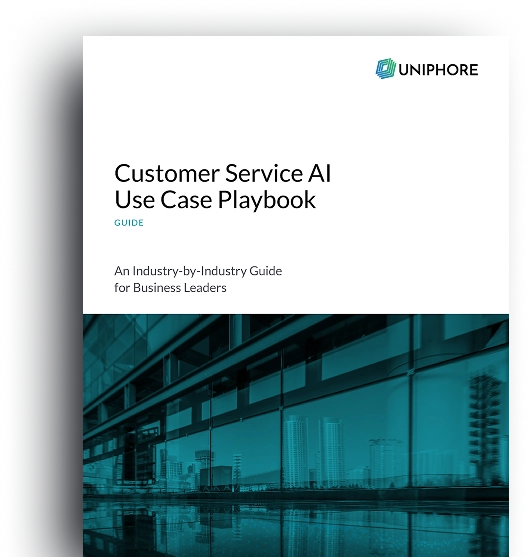
Customer Service AI Use Case Playbook
An Industry-by-Industry Guide for Business Leaders
Start with “quick win” AI use cases
Here’s the truth: the first use cases you select will set the tone for your entire AI rollout. Like any business investment, customer service AI needs a solid foundation to validate its cost and achieve meaningful ROI. By focusing on “quick win” AI use cases, customer service leaders can earn executive buy-in and build momentum for broader adoption.
What makes a customer service AI use case a “quick win”? The answer is how fast it can improve a key function or process. Quick wins typically prioritize:
- Time to value: customer service AI can deliver value in months, not years. (Some enterprises achieve break-even in as little as four months.)
- Return percentage: well-chosen use cases can deliver ROI in the triple (and even quadruple) digits.
- Financial impact: depending on the use case, AI pilots can unlock millions in incremental revenue or savings.
When defining early use cases, keep it simple. Focus on areas where you can make a measurable impact with minimal heavy lifting, like lowering average handle time (AHT) or improving your first call resolution (FCR) rate. Be sure to consider whether your pilot can scale beyond its initial use case.
Customer Service AI use cases by industry
Below are examples of foundational AI use cases across multiple industries. (You can see a more in-depth list in our Customer Service AI Use Case Playbook.) These use cases are popular for a reason: they deliver quick ROI wins and create a scalable base for AI expansion.

Finance
AI use cases: Fraud detection and prevention, personalized CX, compliance automation, KYC (Know Your Customer) optimization
ROI wins: Closed security gaps, higher customer engagement, 100% regulatory compliance, minimized data risks

Telecommunications
AI use cases: Revenue generation, customer support optimization, collections management, agent lifecycle
ROI wins: Increased conversions and upselling/cross-selling, improved CSAT and FCR, higher recovery rates, lower agent turnover

Healthcare
AI use cases: Self-service adoption, after-call work (ACW) automation, patient journey optimization, overpayment detection
ROI wins: Reduced call volume, waiting time, and live support cost, improved CSAT and FCR, reduced recovery costs

Travel & Hospitality
AI use cases: Agent onboarding and lifecycle, traveler experience optimization, promise management automation
ROI wins: Reduced training time and agent turnover, improved CSAT, fewer repeat calls

Retail
AI use cases: Agent training optimization, sales generation, customer lifetime value (CLV), agent retention
ROI wins: Faster training for full-time and seasonal staff, increased conversions and repeat business, lower agent turnover

Technology
AI use cases: Self-service optimization, agent proficiency, sales enablement
ROI wins: Reduced call volume and handle times, improved performance KPIs, increased conversions and upselling/cross-selling
Choosing the right platform to support your AI foundation
While these use cases are popular launching points for businesses starting their customer service AI journey, their success hinges on one thing: the platform that supports them. The ideal platform should have the capabilities to meet your current needs with the flexibility to adapt as your business needs evolve. It sounds like a simple combination, but it’s not as common as you think.
Uniphore’s Business AI Cloud is the only sovereign, composable, and secure AI and data platform that gives businesses the control, flexibility, and security to drive all their customer service AI initiatives—today and tomorrow. No data or model restrictions. No vendor lock-in. That’s the power of AI independence: the unrestricted ability to build, deploy, and scale AI to meet real-world needs—from popular, pilot-level use cases to highly specialized industry applications.
Get the guide to learn more
An Industry-by-Industry Guide for Business Leaders