

In today’s enterprise landscape, large language models (LLMs) are no longer just chatbots—they are autonomous agents capable of executing multi-step workflows, interacting with knowledge bases, and performing actions across complex systems. Two paradigms for guiding LLM behavior have emerged as leaders: ReAct and Pre‑Act.
At Uniphore, we identified a key limitation in existing methods, leading us to invent Pre‑Act, a framework specifically designed for structured enterprise workflows.
Understanding ReAct
ReAct, introduced in “Synergizing Reasoning and Acting in Language Models” (Yao et al., 2022), emphasizes interleaving reasoning and action:
- Thought: The model generates internal reasoning
- Action: The model executes a tool, API call, or external function
- Observation: The outcome informs the next reasoning step
This creates a dynamic feedback loop that continues until a final answer can be produced.
Example: Vaccination Assistant (ReAct)
Human: Are people with high blood pressure eligible for vaccination?

Thought: Query the Knowledge Base for high blood pressure eligibility.
Action:
{
  "action": "Knowledge_Base_Query",
  "action_input": {"query": "High blood pressure eligibility", "access_token": "ACCESS_TOKEN_123"}
}
Observation: Individuals with high blood pressure are eligible.

Thought: Respond to the user.
Action:
{
  "action": "Final Answer",
  "action_input": "Yes, individuals with high blood pressure are eligible. Anything else I can help with?"
}
Strengths:
- Flexible and reactive to unpredictable user inputs
- Well-suited for zero-shot reasoning
Limitations for enterprises:
- Multi-step workflows can become inconsistent
- Compliance and auditability are harder to enforce
- Critical steps may be skipped if conversation changes mid-flow
Introducing Pre‑Act
Pre‑Act (arXiv 250a5.09970, 2025) improves upon ReAct for multi-step, structured enterprise workflows. The model plans its reasoning and actions upfront, then executes the plan step by step.
Key Features of Pre‑Act:
- Planning Phase: Generate a multi-step plan before execution
- Execution Phase: Follow the plan to ensure consistency
- Compliance Embedding: Include regulatory and procedural requirements in the plan
- Fine-Tuning Friendly: Models learn structured planning patterns, improving performance on complex tasks
Example: Vaccination Assistant (Pre‑Act)
Human: Can you tell me if people with high blood pressure are eligible and also help me book an appointment?

Thought (Planning): The user has two goals:
1. Check vaccination eligibility.
2. Book an appointment.

Previous Steps:
NA
Next Steps:
Step 1: I will Query Knowledge Base with query: Are individuals with high blood pressure are eligible for vaccination?.
Step 2: Based on the knowledge base response, I will Respond with eligibility info.
Step 3: I will call Check_Agent_Availability tool to check whether a live agent is currently available to handle the appointment request.
Step 4: Transfer call if agent is available.
Step 5: After the transfer, I will conclude the interaction.

Execution Phase:
Action (Step 1): Knowledge_Base_Query(...)
Observation (Step 1): Eligible.
Action (Step 2): Final Answer("Yes, eligible")
Action (Step 3): Check_Agent_Availability(...)
Observation (Step 3): Agent available
Action (Step 4): Call_Transfer(...)
Action (Step 5): Final Answer("Connected to agent. Thank you!")
Advantages for enterprises:
- Predictable multi-step workflows
- Built-in compliance and audit trails
- Reduced errors and hallucinations
- Optimized fine-tuning and generalization for enterprise tasks
ReAct vs. Pre‑Act: Key Differences
| Aspect | ReAct | Pre‑Act | Enterprise Advantage |
|---|---|---|---|
| Reasoning | Interleaved with action | Plan first | Ensures end-to-end workflow adherence |
| Tool chaining | Reactive | Pre-planned sequence | Reduces missed steps across internal systems |
| Observation | Guides next step | Confirms plan | Audit and compliance-friendly |
| Fine-tuning | Stepwise, dynamic | Structured, multi-step | Better generalization and less hallucination |
| Error handling | Step-by-step | Contingency planning upfront | More robust in complex workflows |
Why Pre‑Act Excels in Enterprise AI
Enterprise AI workflows often involve multi-step operations across CRMs, knowledge bases, ticketing systems, and regulatory procedures. Pre‑Act allows these workflows to be planned, executed, and audited consistently.
Example: Enterprise Vaccination Call Center Workflow
Steps:
- Check eligibility via Knowledge Base
- Validate insurance and identity
- Book appointment in scheduling system
- Log interaction in CRM
- Deliver compliance messages
- ReAct: Flexible but may skip steps or miss compliance checks
- Pre‑Act: Plans all steps upfront, guaranteeing compliance, consistency, and traceability
Other enterprise domains where Pre‑Act shines:
- Customer support with multiple integrated tools
- Procurement approval workflows
- IT incident resolution
- HR onboarding
- Financial or insurance risk checks
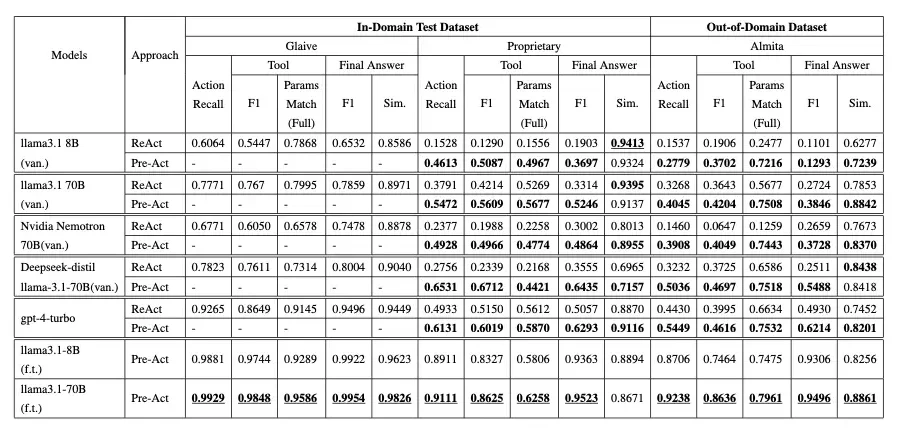
Results
Conclusion
While ReAct is best for reactive, zero-shot reasoning tasks, Pre-Act is best for structured, multi-step enterprise workflows requiring compliance, auditability, and robustness. Based on these advantages, and the results that support them, it is clear: Pre‑Act is the next generation of enterprise AI fine tuning, giving businesses confidence that complex processes will execute reliably—every time.