

Enterprises around the world are no longer asking if they should invest in AI — they’re asking how to make it work at scale. Yet, as a recent MIT study found, only 5% of enterprise AI projects ever make it to production. The challenge isn’t interest or ambition — it’s adoption.
At The AI Boardroom at Nasdaq, Uniphore Co-founder and CEO Umesh Sachdev shared his vision for how enterprises can bridge that gap. The key, he explained, lies in understanding and embracing the three trends driving real-world Business AI adoption — shifts that are redefining how organizations design, deploy, and scale AI to deliver measurable business outcomes.
These trends reflect a new era of innovation: one that is open, composable, sovereign, and deeply focused on trust. And together, they reveal what it will take to move from pilot projects to production-scale performance — from systems of record to systems of action.
Trend 1: Fit-for-purpose models
The first trend Umesh discussed was around the evolution of models themselves.
We’ve all witnessed the incredible rise of large language models — systems capable of processing billions of parameters and performing astonishingly complex tasks. But for enterprises, the path forward looks different.
“We’re moving from large models to fit-for-purpose models — models that are trained on enterprise data, tuned for specific use cases, and optimized for performance, speed, and governance.”
— Umesh Sachdev, Co-founder and CEO, Uniphore
These fit-for-purpose models allow enterprises to focus on accuracy, control, and efficiency — enabling teams to build smaller, more precise systems that deliver measurable ROI instead of generic capability. They capture the intelligence that exists within an organization — its language, its workflows, its decision logic — and make it actionable.
The shift from large, general-purpose models to smaller, domain-specific, task-oriented models marks one of the most important steps toward scalable enterprise AI.
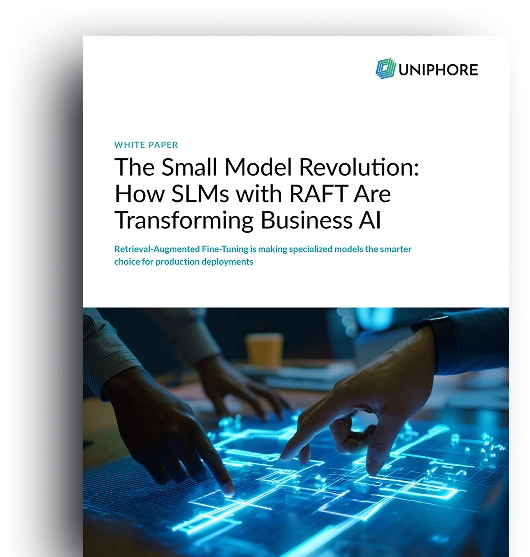
The SLM Revolution
How Small Models and RAFT Are Transforming Business AI.
Trend 2: Open and sovereign platforms
As AI becomes the operating layer of the enterprise, one truth has become clear: control and sovereignty matter.
For years, enterprises have been locked into closed, proprietary ecosystems that limited flexibility and interoperability. That era is ending. The next generation of Business AI will be built on open, composable, and sovereign platforms — systems that let organizations run AI wherever their data and compliance requirements demand.
An open and sovereign approach enables enterprises to:
- Retain ownership of their data and models
- Deploy AI across hybrid and multi-cloud environments
- Adapt quickly to evolving global regulations
This shift ensures that AI doesn’t just work for the enterprise — it belongs to the enterprise. It’s not about choosing one hyperscaler or vendor; it’s about uniting the entire ecosystem to deliver value safely, responsibly, and at scale.
“To scale Business AI, there is no one-size-fits-all solution. It takes an entire ecosystem coming together — from capital providers to compute leaders, AI builders, and integrators — to drive adoption.”
— Umesh Sachdev, Co-founder and CEO, Uniphore
Trend 3: Deterministic agents
The third trend is about trust — the cornerstone of enterprise adoption.
Enterprises are asking how they can deploy AI at scale while ensuring accuracy, transparency, and control. They need AI systems that aren’t just powerful, but predictable — systems they can explain, validate, and rely on to make business-critical decisions.
“Trust, context, and validation give you satisfaction that you’ve got your data right. You don’t need a 10-year project. You just need confidence that you know what’s needed.”
— Umesh Sachdev, Co-founder and CEO, Uniphore
This move toward deterministic AI — systems that deliver consistent, auditable outcomes — represents a shift from experimentation to accountability. It’s what enables leaders to move from pilots to production, from “interesting demos” to enterprise-wide adoption.
By grounding AI in context and validation, enterprises can build systems that scale responsibly — combining human oversight with model-driven intelligence to create AI that earns trust, not just attention.
Business AI From Experimentation to Execution
Together, these trends signal the arrival of a new phase for Business AI — one that is open, composable, secure, and outcome-driven.
Enterprises that embrace this evolution will move beyond pilots and proofs of concept into full-scale transformation. They’ll shift from systems of record to systems of action — intelligent platforms where data, knowledge, models, and agents work in concert to drive measurable results.
At Uniphore, we’re proud to be at the forefront of this movement — helping global enterprises turn AI into ROI through our unified Business AI Cloud. To learn more about how Uniphore helps over 2,000 global businesses, including many of the Fortune 500 to achieve Business Outcomes, reach out to our team.