

At Nasdaq’s MarketSite in New York, Uniphore hosted the AI Boardroom — bringing together AI and data leaders, investors, and innovators to shape the future of Business AI. The event offered a rare look into the conversations happening in real boardrooms today: how leading brands, investors, and ecosystem partners are navigating the accelerating wave of agentic AI adoption.
From the outset, one message echoed throughout the evening: the era of Business AI has arrived, and success will depend not on experimentation, but on execution — on how effectively enterprises adopt, scale, and govern AI to create measurable impact.
From Headlines to Boardroom Reality
Opening the event, Uniphore Co-founder and CEO Umesh Sachdev described a moment of convergence for the AI industry. “We’re seeing the frenzy of headlines,” he said, “but beyond that, we’re beginning to sense that Business AI is taking hold.”
In the next phase of enterprise transformation, AI adoption—not experimentation—will determine the winners. Yet, Sachdev reminded the audience, there is no one-size-fits-all path. Scaling Business AI will require an ecosystem approach — bringing together capital providers, compute leaders, system integrators, software platforms, and innovators to deliver value collectively.
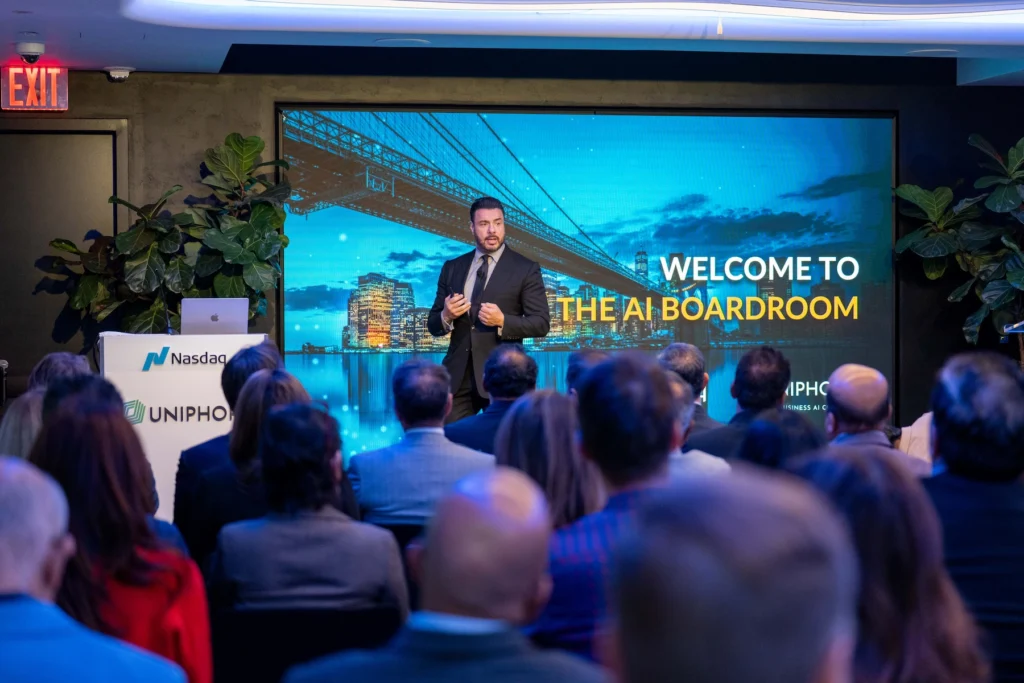
A Defining Vision for The Future of Business AI
The opening keynote set the tone for the evening — defining a bold, clear vision for the next wave of enterprise transformation.
The insight was unmistakable: Business AI adoption will determine the winners and laggards of the next decade. Intelligent agents are moving from concept to reality — reshaping how organizations operate, decide, and grow.
Three defining trends are leading this shift:

Fit-for-Purpose Models: The early wave of AI was powered by massive, generalized large language models. Now, enterprises are moving toward fit-for-purpose small and action models — systems tuned for specific industries, use cases, and departments. These smaller, more efficient models are easier to govern, faster to train, and optimized to deliver measurable business impact.

Open and Sovereign Platforms: As AI moves from the lab into the enterprise, control and flexibility are critical. Leaders are demanding open, composable, and sovereign architectures that allow them to run AI across multiple clouds and data environments, without vendor lock-in. This shift ensures that enterprises can adapt to evolving regulations, preserve data sovereignty, and build long-term resilience.

Deterministic agents: The next phase of AI adoption will depend on trust, validation, and repeatability. Enterprises need AI agents that not only generate outputs but explain how and why decisions are made. Deterministic AI — systems that deliver consistent, auditable results — will become the foundation of enterprise-scale deployment.
Together, these trends define what it means to build an intelligent enterprise — one where AI is not a tool, but a trusted system of action.
The Enterprise Blueprint: Building AI That Scales
Umesh Sachdev shared rindings from recent MIT study that only 5% of custom enterprise AI tools ever reach production — meaning 95% of GenAI pilots fail before they scale. But failure, in this case, isn’t a flaw — it’s the feature of bold innovation.
That’s why Uniphore has been building in lockstep with our 2,000+ global customers, including many of the Fortune 500, helping them make AI work within the realities of regulation, security, and legacy infrastructure — not despite them.
We’re still in the early stages of a massive technological transformation — where risk, experimentation, and iteration define the winners.
Uniphore shared its model for this transformation — a complete stack that powers the agentic enterprise with an AI platform spanning data, knowledge, models, and agents.
Data Layer: Unlocks instant, secure, zero-copy access to data wherever it lives — no copies, no migrations, no complexity.

Knowledge Layer: Transforms complex enterprise data corpus into structured, contextualized and governed knowledge.
Model Layer: unified orchestration, automated fine-tuning, and high-performance inference — built for enterprise scale.

Agentic Layer: Develop, deploy and manage AI agents that automate complex business processes using a natural language builder and orchestration layer.
Explore the full platform here.
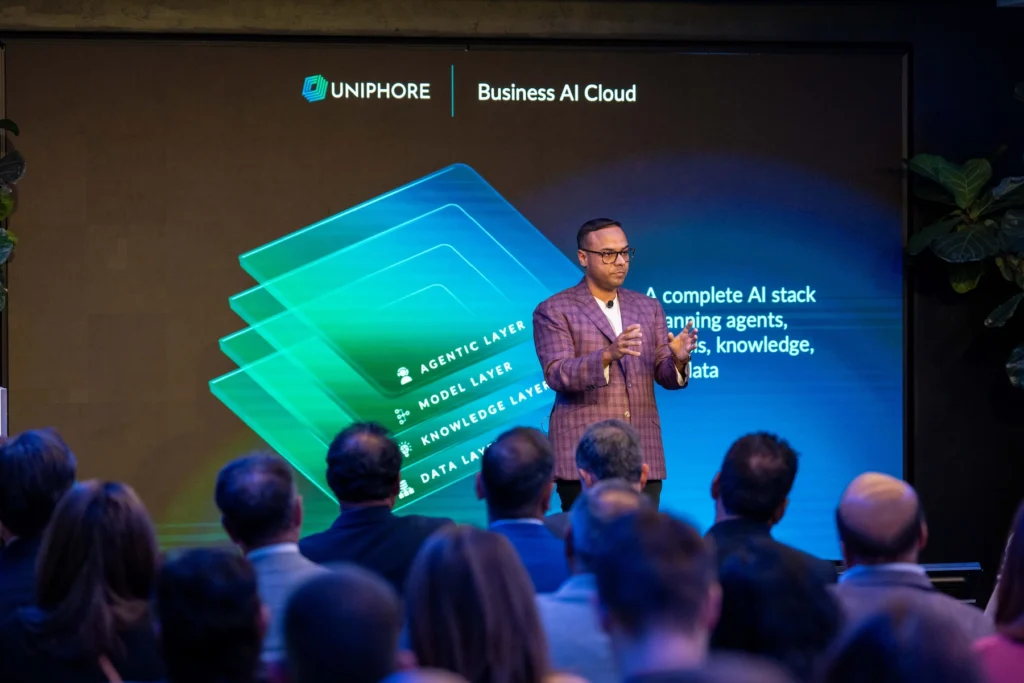
Uniphore is built to be Sovereign, supporting AI deployments across on-prem, cloud and multi-cloud; Composable, working with any model, app, agent, or data source; and Secure, providing frontier research for AI security.
- Sovereign — Run on any public cloud, private cloud or on-premises with full control over your data and AI models.
- Composable — Choose your layer, model, or component—vector DBs, knowledge graphs, data compute, and beyond.
- Secure — Embedded guardrails, observability, and AI security ensure trusted, compliant, and enterprise-grade protection.
This architecture is already powering a new generation of enterprises — enabling them to move from isolated AI pilots to large-scale, outcome-driven deployment.
Panel 1: Inside the Boardroom — Critical AI Decisions
The first panel took the audience inside the boardroom, revealing the debates that are happening in boardrooms today.
As organizations navigate a dynamic environment, what is the view of the enterprise market? What journeys are they seeing? What obstacles and successes are enterprise leaders seeing? What processes should we automate? What are the use cases that stand out?
The group discussed how we should we think about the ecosystem spanning hyperscalers, AI providers, service providers, and so many others — breaking down the choices that matter the most today.
Here are three key takeaways from the conversation.
Trust and governance are the foundation of scale. Enterprises can’t expand AI without confidence in its accuracy and alignment. The conversation focused on establishing frameworks for data integrity, model validation, and human-in-the-loop oversight, ensuring AI decisions are explainable and compliant with enterprise policies.
Open and sovereign platforms are the enabler of enterprise control. Leaders agreed that the age of proprietary, closed systems is ending. The future lies in interoperable ecosystems that connect data, knowledge, and models while maintaining control over infrastructure and security. This approach ensures scalability across geographies and regulatory landscapes.
Systems of record are evolving into systems of action. Traditional CRMs, ERPs, and HR platforms have long served as repositories for enterprise data — but not decision-making. The panel emphasized that these static systems are being reimagined as dynamic, agentic platforms that can learn from workflows, act on insights, and orchestrate business processes in real time.
AI at scale requires both technical readiness and organizational trust — and the enterprises that master both will lead the next phase of transformation.
A Live Glimpse into the Future: Agentic Process Discovery
A defining moment of the event was the live demonstration of Uniphore’s breakthrough innovation — Agentic Process Discovery.
For the first time, audiences saw how AI can observe a user working in a system like Salesforce, automatically learn the workflow, generate a process map and documentation, and instantly create the corresponding intelligent agents.
Without engineering effort or manual process mapping, the platform:
- Captured how the real work gets done
- Generated a standard operating procedure
- Fed that knowledge directly back into the agentic CRM — in real time.
This breakthrough removes one of the biggest barriers to enterprise AI adoption: the lack of accurate, documented process knowledge.
It was more than a product demo — it was a glimpse into the future of how the agentic enterprise will replace SaaS.
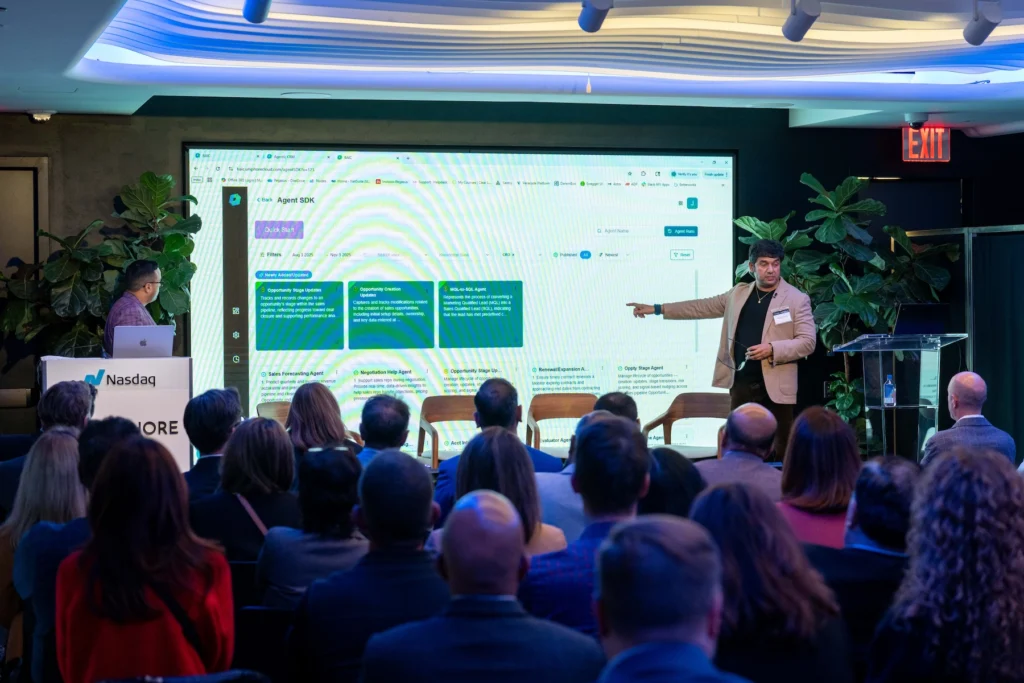
Panel 2: The Agentic Enterprise — Replacing SaaS With AI Agents at Scale
The second discussion looked ahead — to how agentic systems will transform the structure of business itself.
The group explored what it takes to build an enterprise run by agents, how it will change technology, operations, and business models, and how businesses can prepare their teams for this transformation.
Moving into the agentic enterprise — ultimately replacing SaaS with AI agents at scales — AI and data leaders dived into the realities of moving from pilot to deploying AI agents at scale, from data readiness to model choice, from change management to integrations, and ultimately, how leaders can measure success.
Three key themes defined the conversation.
SaaS is transforming into agentic systems. The familiar software model — siloed, form-based, and manual — is being replaced by autonomous AI agents that can reason, act, and adapt. These agents don’t just support human users; they execute multi-step business processes, learn from outcomes, and improve continuously. This marks a profound shift in how enterprise technology delivers value.
Data is the fuel that powers the agentic stack. Every enterprise must start by unifying data, knowledge, models, and agents into a single connected ecosystem. Without a reliable data foundation, even the most advanced agents can’t deliver accurate or contextual insights. Panelists noted that data governance and context engineering will become essential disciplines for scaling agentic systems.
Open, hybrid ecosystems will define the winners. Enterprises are demanding flexibility — the ability to deploy and orchestrate AI across cloud and on-premise environments, with strong cybersecurity and compliance guardrails. This hybrid approach ensures that agentic systems can coexist with existing SaaS investments, creating a bridge between legacy systems of record and next-generation systems of action.
The takeaway: the move toward agentic enterprises is not theoretical. It’s already happening — and it’s redefining productivity, ROI, and the enterprise operating model.
A United Ecosystem Driving the Next Wave of Business AI
As Umesh shared, the future of Business AI won’t be built in silos — it will be powered by a connected ecosystem. Scaling AI across the enterprise demands more than technology; it requires capital providers, compute leaders, AI builders, system integrators, and software innovators all moving in sync.
That collaboration was on full display at Nasdaq and Uniphore is proud to stand at the tip of that spear, helping enterprises connect data, knowledge, models, and agents into unified platforms that make AI truly actionable. With over 2,000 customers worldwide, the company continues to prove that when AI is built for business outcomes — not just experimentation — adoption follows.
Fueled by customer partnership, strategic collaboration, and relentless innovation, Uniphore and its ecosystem are proving that the agentic enterprise isn’t just possible — it’s already taking shape.

Celebrating the Builders of Business AI
The evening concluded with a reception — a moment to celebrate the people and partnerships making Business AI a reality.
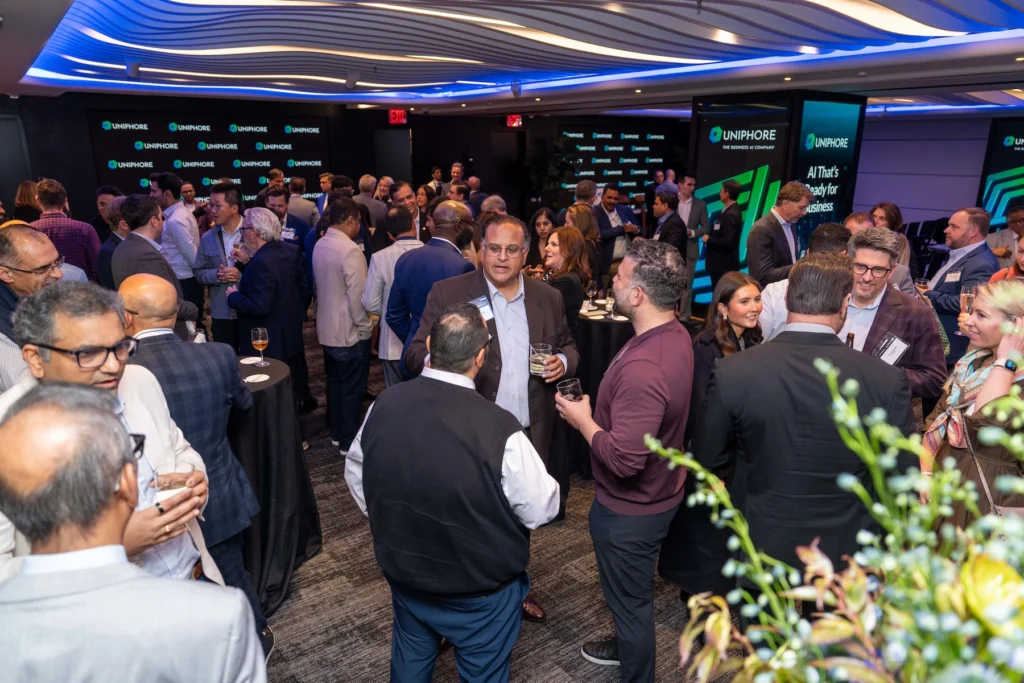
For Uniphore, this event reflected what defines its journey — collaboration, innovation, and execution at scale.
As the night closed, one truth stood above all: the agentic era isn’t on the horizon — it’s happening now. And it’s being built by those bold enough to lead it.
You can watch the replay of the event here, with the key trends leading the next wave of Business AI and a demo of Uniphore’s Process Discovery Agent.