

The “intelligence tax” is real, and businesses are increasingly paying it in money, data, and control. This three-part series explores the compounding costs of vendor AI dependency and the growing shift toward enterprise AI sovereignty.
TL;DR
The recent suspension of Anthropic’s Fable 5 and Mythos 5 models and OpenAI’s court-ordered data retention exposed serious shortcomings in frontier AI: the reality of model blackouts and exposed data, including proprietary data. Enterprises that rely exclusively on LLM-based systems “rented” from third-party vendors may be putting their competitive intelligence at risk. In contrast, self-hosted, domain-tuned SLM systems are immune from vendor interference and disruption and can be dramatically cheaper than frontier APIs.
The Frontier AI Tipping Point
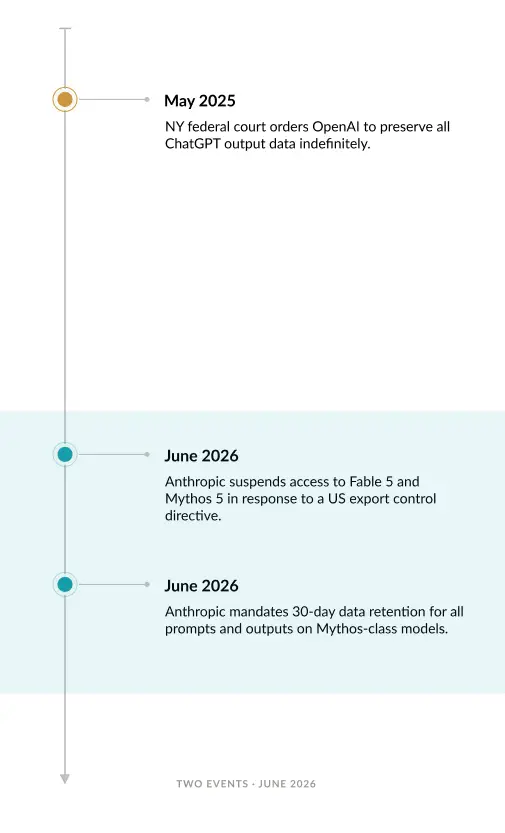
On June 12, 2026, the US government issued an export-control directive ordering Anthropic to suspend all access to its most powerful AI models — Fable 5 and Mythos 5 — for any foreign national, whether inside or outside the United States, including Anthropic’s own employees. The order arrived at 5:21 p.m. ET. By the end of the day, both models were disabled for every customer on earth. No migration window, no grace period and no negotiation.
That same week, Anthropic introduced mandatory 30-day data retention for all prompts and outputs on Mythos-class models for every platform with no opt-out. Microsoft responded by blocking Fable 5 from its own internal GitHub Copilot deployments, according to PYMNTS — because the retention clashed with the zero-data promise Microsoft had made to its customers.
Before that, in May 2025, a federal court in New York ordered OpenAI to preserve all ChatGPT output data indefinitely, including deleted conversations, as part of the New York Times copyright litigation. Enterprise and zero-data-retention API customers were excluded, but every standard-tier user’s prompts are now being preserved under a court order they didn’t agree to.
TIMELINE
A Telling Year for Frontier AI and Its Users
Rented intelligence and the risk to proprietary data
These are not hypothetical risks. They are events from the past twelve months. And they expose a structural dependency that most enterprise AI strategies have not priced in: when your intelligence is rented, your access, your continuity, and—most alarmingly—your proprietary data belong to someone else.
The pattern isn’t new. Enterprises have seen it before in cloud, in SaaS, and in every platform shift: the organizations that rent capability get started faster, but the ones that own the layer that matters build the durable advantage.
In AI, the layer that matters is intelligence itself. More specifically, it is the system that turns raw model capability into enterprise action: domain-tuned models, workflow context, governance, and feedback loops. And the cost of renting that system is higher than most people realize.
Your Proprietary Data is Yours.
What About Your Intelligence?
Explore the four foundations of AI independence—and how you can achieve total enterprise sovereignty.
The intelligence tax
There is a cost to renting your intelligence from someone else: an “intelligence tax” that extends well beyond the API bill. This tax is the accumulated cost of depending on a capability you do not own, one that can be revoked, repriced, retained, or restricted at any time by a provider you do not control.
Start with the bill itself. At 100,000 agent interactions per day, the annual cost at current list prices (author’s estimates based on stated assumptions):
Claude Opus 4.8: $3.83 million per year
At $15 input / $75 output per million tokens.
GPT-5.5: $1.37 million per year.
At $5 input / $30 output per million tokens.
A self-hosted fine-tuned 7B model on two H100 GPUs: $94,000 per year, all-in.
Hardware amortized over three years, power, cooling, maintenance, and a quarter of an MLOps engineer.
The self-hosted option is 14× cheaper than GPT-5.5 and 41× cheaper than Opus. Even if you double the staffing assumption to a full FTE of MLOps support — $200K loaded — the self-hosted cost rises to $244K, still nearly 6× cheaper than GPT-5.5. The breakeven is roughly 6,000 interactions per day against GPT-5.5, and 2,500 against Opus. Any enterprise running agents at production volume is well past both thresholds.
The math changes at enterprise scale. A company processing 10 million AI-assisted decisions per day (routing, classification, anomaly detection, customer intent) runs the same arithmetic at 100× the volume. The self-hosted advantage widens. But the architecture is rarely all-or-nothing. The practical move is to identify the high-volume, domain-specific workloads where a fine-tuned model matches the frontier and to migrate those first. The exploratory, cross-domain, low-volume work stays on the API. The intelligence tax applies specifically to the workloads you should own but don’t, and at enterprise scale, those workloads are where most of the tokens go.
Optimize—and control—your proprietary data with SLMs
Every enterprise AI leader now faces the same hidden choice: pay the intelligence tax forever or invest in owning the capability that compounds.
That capability, enterprises are discovering, exists in small language models (SLMs).
The reasons are simple: most enterprise work is narrow, repetitive, governed, latency-sensitive, and deeply shaped by proprietary context. That is exactly where smaller, domain-tuned models win for certain use cases over generalist LLMs: lower latency, lower cost, tighter control, easier fine-tuning, clearer governance boundaries. An SLM is not just a cheaper LLM. In the enterprise, it is often the better operating unit.
Because SLMs are enterprise owned, all proprietary data stays within the enterprise. It cannot be harvested for frontier LLMs or shared with third-party partners (unless specifically designed to do so). They’re also immune from vendor blackouts, like the Anthropic blackout mentioned earlier.
The writing is on the wall: SLMs, not frontier generalists, will inevitably become the native architecture of enterprise AI. Those organizations that embrace SLMs today won’t just break free of the intelligence tax; they’ll have a compounding advantage of their lagging peers.
Frequently Asked Questions (FAQs)
The intelligence tax is the accumulated cost of depending on a capability you do not own, one that can be revoked, repriced, retained, or restricted at any time by a provider you do not control.
AI tokens are the smallest units of data used for AI computation. A single agentic workflow execution can consume 15,000 to 80,000 tokens as the model retrieves context, reasons through steps, calls external tools, and validates its outputs. While flagship LLMs run at nearly $5 per million output tokens for standard models, and up to $60 for advanced reasoning models, self-hosted, fine-tuned SLMs consume significantly fewer tokens (and are exponentially cheaper) without sacrificing performance.
Small language models (SLMs) are AI models designed for natural language processing (NLP) tasks but built with significantly fewer parameters than traditional large language models (LLMs). A typical SLM contains under ~30–70 billion parameters and is optimized for efficiency, task specialization, and deployment on constrained infrastructure. SLMs are trained using similar techniques as LLMs — including transformer architectures and large datasets — but are optimized for efficiency, specialization, and deployment flexibility.
In many enterprise cases, yes. LLMs are ideal for exploratory, cross-domain, low-volume work. However, SLMs excel at day-to-day enterprise tasks, where work is narrow, repetitive, governed, latency-sensitive, and shaped by proprietary context (i.e. compliance reviews, claims processing, customer routing, contract analysis). By design, they offer lower cost, faster inference, better privacy control, and easier deployment on private infrastructure and often match or outperform larger models on specific, domain-trained tasks.