
Revenue Leakage
Recover revenue that slips through the cracks
Detect contract leakage, billing discrepancies, and compliance gaps across systems to improve recovery and reduce loss with the Uniphore Business AI Cloud.
THE CHALLENGE
Revenue leakage is widespread. Detection is fragmented and reactive.

Contract terms and obligations are not consistently enforced

Billing discrepancies and overpayments go undetected

Revenue leakage is identified late, if at all

Recovery depends on manual audits and investigations
The Business AI Cloud Solves That
The Uniphore Business AI Cloud operates across enterprise systems to ensure that revenue-impacting work is carried out consistently and in line with defined rules, contracts, and policies.
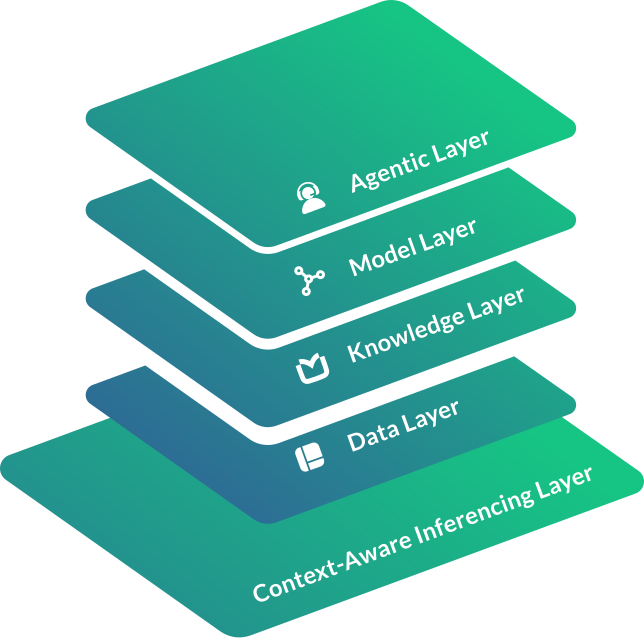
- Agentic layer — Autonomous agents that detect, act, and remediate in real time
- Model layer — Intelligence that identifies leakage, deviations, and risk
- Knowledge layer — Encoded pricing, terms, and compliance context
- Data layer — Unified revenue data across contracts, billing systems, and transactions
1-3%
Recovery of average contract value typically lost to leakage
70-80%
Reduction in manual audit time
50%
faster financial close through automation of reconciliations and variance explanations
HOW IT WORKS
Detect, validate, and recover revenue across systems and workflows
01
Capture operational activity
Capture data across contracts, invoices, billing systems, and transactions.


02
Understand execution patterns
Track how revenue-related workflows move across systems, vendors, and teams.
03
Detect deviations in real time
Identify mismatches between contracts, invoices, and actual execution.
04
Take action with AI agents
Flag discrepancies, route issues, and initiate resolution workflows.
05
Maintain full traceability
Create verifiable records of decisions, actions, and outcomes.
OUTCOMES
Revenue operations with greater visibility and control

Reduced leakage from contract non-compliance and billing discrepancies.

Earlier detection of issues before they scale.

Faster resolution of disputes and exceptions.

Improved accuracy across invoicing and billing workflows.

Full traceability across revenue-impacting processes.
KEY USE CASES
Apply execution control across revenue workflows

Contract compliance and execution
Ensure terms, pricing, and obligations are followed during execution

Invoice validation and discrepancy detection
Identify mismatches across invoices, contracts, and delivery before payment

Billing dispute management
Standardize and accelerate resolution across regions and systems

Fraud and anomaly detection
Detect patterns and deviations across transactions and markets
WHY UNIPHORE
Built for enterprise-grade revenue recovery
- Domain-specific SLMs trained on contract leakage, fraud detection, and compliance
- MCP-native data integration connects every billing, contract, and usage data source
- AI agent automation closes the loop from detection to recovery
- Composable architecture integrates with your ERP, procurement, and billing systems
FAQ
Revenue leakage occurs when a business fails to collect money it is contractually owed — through billing errors, unenforced contract terms, undetected overpayments, or gaps between what was agreed and what was invoiced. It typically happens not because data is missing, but because that data is spread across disconnected systems that are never validated against each other. As transaction volume grows, the gap between what should be collected and what actually is widens without anyone seeing it clearly.
Most organizations detect revenue leakage through periodic manual audits — which means issues are identified weeks or months after they occur, if at all. The core problem is that contracts, invoices, billing systems, and transaction records live in separate systems that are rarely reconciled in real time. Without a unified view across those systems, discrepancies go undetected until they accumulate into material losses.
AI detects contract leakage by continuously comparing actual billing and transaction data against the terms, pricing, and obligations encoded in contracts. Rather than waiting for a manual audit, AI models identify mismatches as they occur — flagging discrepancies between what was agreed, what was invoiced, and what was paid. This shifts detection from a reactive, periodic process to a continuous one that catches issues before they compound.
AI validates invoices by cross-referencing them against contracts, delivery records, and pricing agreements in real time — before payment is made rather than after. When a mismatch is detected, AI agents can flag the discrepancy, route it to the appropriate team, and track resolution across systems. This reduces the time spent investigating disputes manually and creates a consistent, traceable process regardless of region or volume.
The Uniphore Business AI Cloud uses MCP-native data integration to connect directly to existing ERP, procurement, and billing systems without requiring replacement or major reconfiguration. It unifies contract, invoice, and transaction data across those sources and applies AI agents and governance controls on top of your current infrastructure. This means revenue recovery workflows can be up and running without disrupting the systems finance and operations teams already depend on.
Stop leaving revenue behind
Improve visibility, enforcement, and recovery across revenue workflows with the Uniphore Business AI Cloud.