



Marketing Has an Operational Problem,
Not a Data Problem
The customer data platform (CDP) was built to solve a data problem: how to unify customer data across systems, govern it, and activate it. That problem is now solved.
Today’s challenge is operational: how can marketers understand every customer better than before? Not better on average, but better one person at a time. That answer doesn’t come from a customer record alone. It comes from intelligence.
Marketing AI is that intelligence
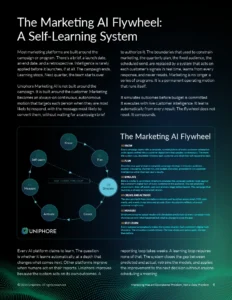
Marketing AI is the transformative layer between data and intelligence that marketing teams have been missing. Unlike static CDPs, marketing AI is always learning and improving. With the right foundation, it becomes a flywheel that helps marketing make better decisions with every campaign and every customer engagement.
This guide explores what that flywheel looks like at the enterprise level. Inside, you’ll learn how a marketing AI platform built on small language models (SLMs) can:
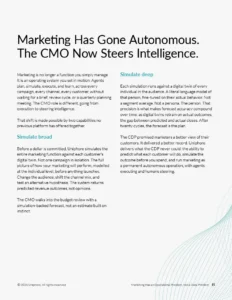
- Enable teams to simulate whole campaigns before spending a dollar
- Generate more accurate forecasts than those built on segment averages
- Continuously and autonomously improve with every interaction
- Create a competitive advantage that that’s difficult to replicate
Dive deeper into marketing AI
How does Uniphore’s Marketing AI platform address core marketing intelligence problems? Which industry leaders are already using marketing AI? How is the role of CMO changing?
Frequently asked questions (FAQ)
A customer data platform (CDP) is a technology used by marketers and customer experience professionals to unify, analyze, and activate customer data across all channels. At its core, a CDP is a system of record for enterprise customers. A marketing AI platform, by contrast, is a system of intelligence. Teams use marketing AI to better understand customer behavior and make accurate marketing predictions. Advanced marketing AI platforms can even simulate whole campaigns before they’re rolled out.
Most marketing platforms are built around the campaign or program. Uniphore’s Marketing AI platform, however, is built around the customer. It uses small language models (SLMs) that learn from every interaction (clicks, purchases, service calls, etc.) to understand how each customer behaves. Using this always-on, agentic system, marketing teams can simulate campaigns at the customer level, execute actions autonomously, and create increasingly accurate forecasts using intelligence that compounds with each cycle.
Nearly every organization today uses a CDP for marketing strategy. However, this strategy routinely fails, not because data is bad, but because models built on segment averages predict a fictional average customer. Marketing AI replaces this fictional average customer with individual-level customer intelligence. This enables marketing teams to make more accurate predictions and execute more effective campaigns than their peers. And because it comes from internal, proprietary intelligence, it’s an advantage that’s difficult for competitors to replicate.