


Every enterprise budgets for AI the same way. There’s a subscription line, a per-token rate, and maybe a platform fee. On paper, everything looks manageable. Then the workloads scale and the cost skyrockets.
It’s a pattern that’s become all too familiar. Just last month, Amazon came into the spotlight for spending $1.8 billion on a failed AI project. Two months before that, news broke that Uber had already burned its entire 2026 AI budget on Claude code.
These aren’t isolated incidents by AI novices. These are established tech leaders, and they’re just the latest to learn the hard way about the hidden costs of AI.
How much is your AI costing you?
Find out what’s draining your AI budget and how to fix it.
Why it’s so hard to budget for AI
AI isn’t like other enterprise solutions. Organizations used to SaaS pricing models are now scratching their heads wondering what went wrong. As a result, businesses from Meta to Walmart are doing what makes the most sense: capping AI budgets to staunch the bleeding.
Why is AI so hard to budget for? Because agentic AI doesn’t behave like a simple chatbot query. When you factor in reasoning chains, tool calls, retries, and multi-step execution, a single workflow can generate exponentially more tokens than a basic prompt would. And while per-token pricing might be trending down, total consumption isn’t. As a result, the gap between “what we budgeted for AI” and “what AI actually costs at scale” widens with every workflow added.
But that’s just one part of the equation. There are more hidden costs, and they don’t show up on any invoice.
It’s not just what you pay. It’s what you give up.
Runaway token consumption may be making headlines, but there are other factors putting enterprises at the losing end of the AI bargain. In his three-part series, “The Intelligence Tax”, Will Lu, VP of Engineering and Head of AI Strategy for Uniphore, revealed how enterprises that “rent” their AI from frontier vendors put their proprietary data at risk:
“When your intelligence is rented, your access, your continuity, and most alarmingly, your proprietary data belong to someone else.”
Every query sent to a third-party model is a data transaction. Your proprietary workflows, customer information, compliance logic, and domain expertise all leave your perimeter with every call.
What happens to that data next isn’t fully in your hands, and the risks aren’t hypothetical. In June, Anthropic suspended access to its most powerful AI models, Fable 5 and Mythos 5, in response to a government-issued export-control directive. Before that, in May 2025, a federal court in New York ordered OpenAI to preserve all ChatGPT output data indefinitely, including deleted conversations, as part of the New York Times copyright litigation.
Regulatory pressures shift. Data retention policies change. Access can be restricted without warning. And there’s little enterprises can do to stop it. Control is in the hands of the vendors, not with the companies that rely on the solution day in and day out.
There’s a slower, more strategic cost too. The intelligence embedded in your data (the patterns, edge cases, and domain knowledge that make your business yours) is your competitive advantage. Every time that data flows through someone else’s model, some of that advantage risks becoming someone else’s training signal instead of your own.
Rented AI favors the landlord, not the user.
Maybe the most overlooked cost is the one that plays out over years, not quarters: a rented model resets with every call. An owned model learns. In year one, that difference is barely noticeable. By year three, it can be the difference between an enterprise that’s compounding its intelligence and one that’s still paying the same rate it paid on day one, with nothing to show for the spend beyond that quarter’s output.
The enterprises that come out ahead in the next decade won’t be the ones with access to the biggest, most powerful model. They’ll be the ones that own their intelligence: models trained on their data, deployed on their infrastructure, governed by their policies, and compounding with every interaction.
The contract isn’t the problem. The architecture is.
The solution for enterprises isn’t a better negotiated rate or a bigger token allotment. It’s rethinking how enterprise AI is architected. Most enterprise work (i.e., compliance reviews, customer routing, claims processing, contract analysis) doesn’t need a massive, general-purpose model. In these cases, frontier LLMs are nothing short of overkill.
What enterprises need instead is intelligence that’s tuned to the task, deployed on infrastructure the enterprise controls, and designed to improve with every interaction rather than start fresh each time.
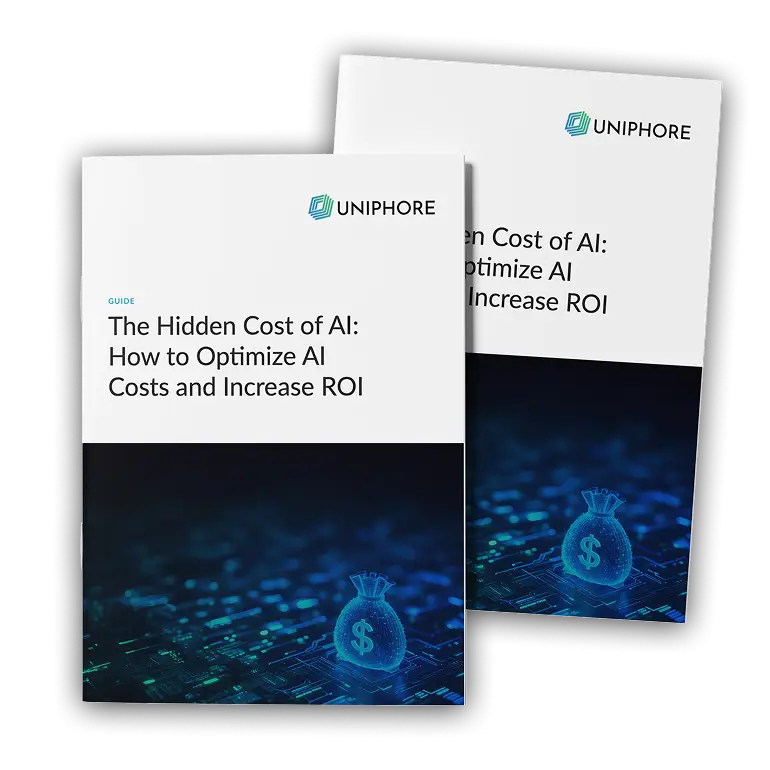
In our guide, The Hidden Cost of AI: How to Optimize AI Costs and Increase ROI, we break down exactly where today’s hidden costs live, what they’re quietly costing enterprises, and what organizations can do to take back control of the intelligence that forms their competitive advantage.
Ready to stop paying hidden AI costs?
Learn what you can do in our guide for enterprise leaders.