
Multimodal Data
Takeaways for Tech Leaders
- Multimodal data refers to information that exists in multiple formats simultaneously — text, audio, video, images, and structured data — and is increasingly foundational to how enterprise AI understands real-world business context.
- Unlike single-format AI inputs, multimodal data gives AI systems a richer, more complete picture of what’s happening in a business process, customer interaction, or operational workflow.
- The biggest barrier to unlocking multimodal data in the enterprise isn’t collecting it — it’s structuring, governing, and connecting it to AI workflows without copying or migrating sensitive data.
- Enterprises that treat multimodal data as a unified intelligence resource — rather than siloed audio, video, or document repositories — are better positioned to deploy AI that reflects how work actually happens.
What Is Multimodal Data?
Multimodal data is any dataset that combines two or more distinct types of information — such as text, audio, images, video, and structured records — to provide richer context than any single format could alone. In modern enterprises, multimodal data enables enterprise AI platforms to process the full complexity of how business information is created, communicated, and consumed.
An inbound customer call, for example, generates a wealth of multimodal data in the form of audio (the voice interaction), text (the transcript), metadata (timestamps, agent IDs, call outcome codes), and sometimes screen recordings — all simultaneously. When AI can ingest and reason across all of these formats together, its outputs are more accurate, more context-aware, and more useful than when it works from any single source.
Read on to learn why multimodal data is fast becoming an enterprise prerequisite and how next-generation platforms, like Uniphore’s Business AI Cloud, are enabling organizations to render multimodal data ready for enterprise AI applications.
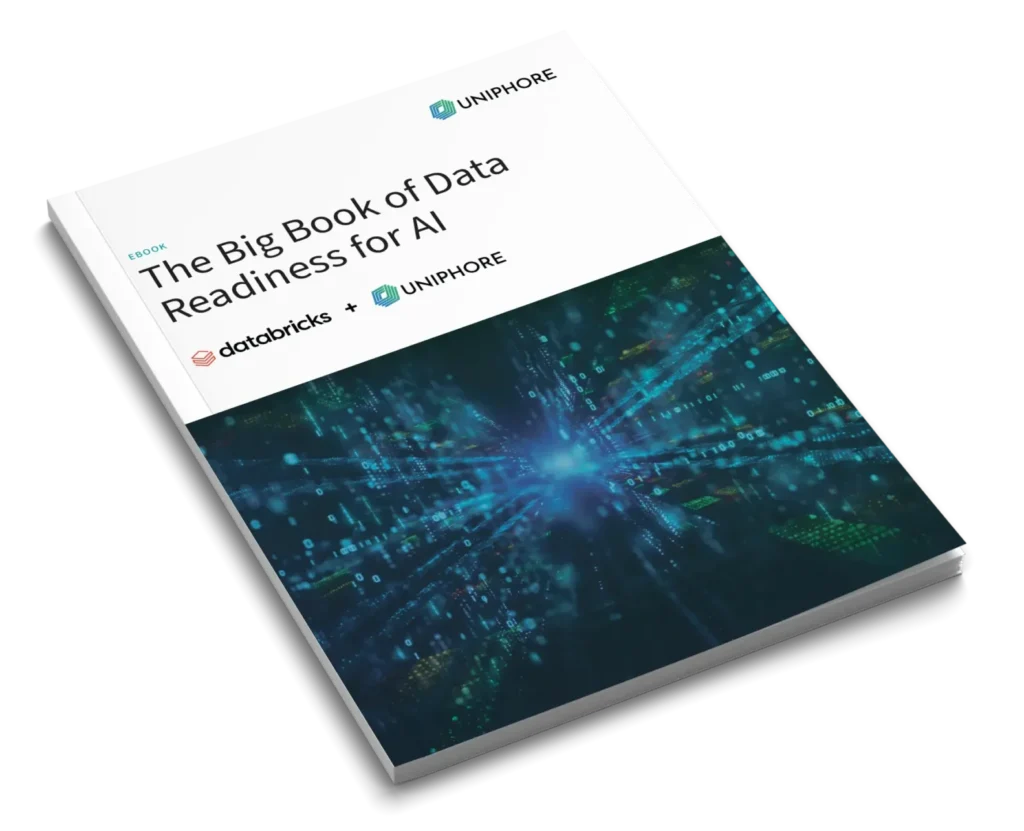
The Big Book of Data Readiness for AI
Learn how to prepare multimodal data for today’s enterprise AI use cases.
Why Multimodal Data Matters for Enterprise AI
Enterprises today are sitting on a mountain of multimodal data. It lives in audio recordings, video calls, PDFs, email threads, contracts, and images. But there’s a caveat: as much as 90% of it is unstructured, according to Forbes.
That’s a problem for traditional AI systems. These systems were largely built for structured data: rows, columns, and numerical values that behave predictably. Multimodal data was never factored into their architecture. As a result, many enterprises operating on legacy platforms experience a significant gap between where enterprise knowledge actually lives and where AI can reach it.
But that’s changing. Modern AI platforms, like Uniphore’s Business AI Cloud, use a composable architecture that enables integration across data types, allowing the data to be AI-ready. As a result, enterprises can now leverage everything within their data pipeline—regardless of channel or file format—for AI purposes.
That’s an enormous advantage.
When AI systems can simultaneously understand a spoken word, interpret a facial expression or screen activity in a video, parse a document, and correlate these signals with structured records in a CRM or ERP, they produce fundamentally better outputs. The difference shows up in customer service that analyzes tone alongside transcript, in document intelligence workflows that extract meaning from charts and prose together, and in sales coaching tools that assess both what was said and how it landed.
The Five Most Common Types of Multimodal Data in the Enterprise
Text
Text is the most widely processed format in enterprise AI — spanning emails, chat logs, support tickets, contracts, policies, reports, and knowledge bases. Text provides the narrative structure of business knowledge. It is the primary input for large language models (LLMs) and is often used as an anchor format to which other data types are linked.
Audio and Voice
Audio is among the richest sources of business intelligence, encompassing call recordings, voicemails, meeting transcripts, and voice notes. Audio-derived data — transcripts, speaker diarization, acoustic features — bridges voice interactions with the rest of the enterprise data stack. To capture the full value of audio data, businesses are increasingly adopting communication recording agents that prepare unstructured audio recordings for AI usage.
Video
This includes screen recordings, video calls, product demos, and training sessions. In digital customer-facing interactions, screen recordings capture agent behavior alongside voice, enabling quality management and process mining that would otherwise require manual review. In manufacturing and healthcare, video is used for quality control and clinical observation, respectively.
Images and Documents
Scanned contracts, insurance claim forms, medical records, invoices, and product images are another major data source. These formats combine visual structure (layout, typography, embedded tables or charts) with textual content — requiring AI that understands both. Document AI and optical character recognition (OCR) are foundational here; but modern multimodal models go further, interpreting the semantic meaning of content in context.
Structured and Metadata
Database records, CRM entries, transaction logs, system event data, and interaction metadata, such as timestamps, session IDs, and geographic coordinates, are typical examples of structured data and metadata. Structured data provides the factual scaffolding on which insights from unstructured formats can be anchored. When a customer’s call sentiment score is linked to their account tenure, transaction history, and previous support interactions, the resulting AI output is far more actionable.
Multimodal Data vs. Single-Modal Data: Key Differences
| Dimension | Single-Modal Data | Multimodal Data |
|---|---|---|
| Input types | One format (e.g., text only) | Two or more formats simultaneously |
| Context depth | Limited to one signal | Cross-format context for richer understanding |
| Business applicability | Narrow AI usability | Broad — reflects how enterprise events actually occur |
| Accuracy | Lower in ambiguous scenarios | Higher when signals across formats can be correlated |
| Complexity | Simpler to implement | Requires more sophisticated data handling and model architecture |
| Typical enterprise example | Chatbot reading support tickets | AI analyzing a support call transcript, audio sentiment, and screen recording simultaneously |
Multimodal data doesn’t just enrich enterprise AI systems with additional information—it sharpens its accuracy. This is particularly valuable when systems encounter ambiguity. For example, when text and audio inputs disagree (for instance, a customer saying “sure, that’s fine” in a frustrated tone), multimodal AI can surface the discrepancy. Single-modal systems cannot.
How Enterprise AI Processes Multimodal Data
Processing multimodal data in the enterprise involves several interconnected capabilities:
Ingestion and format normalization
Raw audio, video, documents, and structured records must be ingested and converted into representations that AI models can process. Audio is transcribed; documents are parsed and digitized; video is segmented and described; structured records are formatted and linked to context.
Feature extraction and alignment
AI systems extract meaningful signals from each modality — acoustic features from voice, spatial relationships from images, semantic meaning from text — and align them temporally or contextually. A customer service interaction, for example, requires aligning the audio signal, the transcript, and the CRM record at the moment of each exchange.
Cross-modal reasoning
The most powerful multimodal systems can reason across formats simultaneously — not just process each in sequence. This allows AI to draw inferences that require combining signals: detecting a compliance violation by correlating what was said, how it was said, and what was displayed on screen.
Knowledge grounding and retrieval
To produce accurate, enterprise-specific outputs, multimodal AI must be grounded in relevant organizational knowledge — policies, product catalogs, compliance frameworks. Retrieval-augmented generation (RAG) techniques adapted for multimodal contexts help AI pull the right context from heterogeneous knowledge stores at inference time.
Governance and auditability
Enterprise deployments require that every inference made from multimodal data be traceable — to protect data privacy, meet regulatory requirements (GDPR, HIPAA, CCPA), and maintain the trust of both employees and customers. This means every piece of input data, every model decision, and every output must be logged, governed, and auditable.
Enterprise Use Cases for Multimodal Data
Document and Contract Intelligence
Legal, financial, and clinical documents contain a mix of structured tables, prose, embedded images, and signature blocks. Multimodal AI can extract key clauses, identify risk terms, compare versions, and flag exceptions — tasks that require understanding layout, format, and language together.
Sales Coaching and Enablement
Video and audio recordings of sales calls, combined with CRM data and deal outcomes, enable AI to surface coaching insights — identifying what behaviors correlate with won deals versus lost ones, and delivering targeted feedback to individual sellers. Advanced sales interaction agents go even further, turning multimodal data captured during live engagements into real-time intelligence sellers can use to identify hurdles, overcome objections, and act on engagement cues the moment they arise.
Healthcare Clinical Documentation
Voice recordings of clinical consultations, combined with patient records and clinical guidelines, allow AI to automate documentation, flag potential issues, and surface evidence-based recommendations — without requiring physicians to re-enter information into separate systems.
Fraud Detection and Compliance Monitoring
In financial services and insurance, multimodal data — combining transaction records, voice recordings of customer interactions, document submissions, and behavioral metadata — enables more accurate fraud detection and more comprehensive regulatory compliance than any single data type can support.
Employee Experience and HR
Hiring teams are increasingly turning to AI recruiting agents to analyze multimodal data pooled from video interviews, structured assessments, and written application materials to identify top candidates more consistently and equitably. Similarly, voice and text signals from employee feedback channels can be combined with HR records to surface early indicators of disengagement or attrition risk.
Challenges of Working with Multimodal Data at Enterprise Scale
Data volume and storage
Audio and video data generate large file sizes at scale. For example, a telecommunications help desk that processes thousands of calls per day accumulates petabytes of raw recordings. Enterprises need strategies for managing this volume without compromising accessibility or performance.
Format and quality variation
Enterprise data doesn’t arrive clean. Audio may have variable recording quality; documents may be scanned at different resolutions; structured and unstructured data may be formatted inconsistently across systems. Preprocessing and normalization pipelines are essential.
Cross-modal alignment
Linking data across formats requires careful engineering. A transcript must be aligned to the correct audio segment; a document image must be correlated to the correct structured record. Misalignment produces noise that degrades model performance.
Governance complexity
Multimodal data frequently includes personally identifiable information (PII) across multiple formats simultaneously — a face in a video, a voice in a recording, a name in a document. Governance frameworks must be applied consistently across all formats, which is significantly more complex than governing structured data alone.
Latency and compute cost
Processing multiple data types simultaneously requires more compute than single-modal inference. Use cases that operate in real time demand both accuracy and low latency, which requires architectural investment in model efficiency and inference optimization.
Data sovereignty
Multimodal data is often highly sensitive. Enterprises increasingly require that it be processed and retained in specific geographic environments, without being copied or moved to third-party cloud environments. This makes sovereign, zero-copy data architectures a practical requirement rather than a preference.
What to Look for in an Enterprise Multimodal AI Platform
AI platforms are increasingly factoring multimodal data into their underlying architecture. But the ability to process multiple datasets alone isn’t enough to drive meaningful AI outcomes. To do so, a platform must weave multimodal data into an enterprise’s broader knowledge stream.
The Knowledge Layer in Uniphore’s Business AI Cloud, for example, structures and contextualizes multimodal data into AI-ready knowledge retrieval. Enterprises can then use this to continually fine-tune small language models (SLMs), ensuring models remain perpetually accurate and up to date.
| Evaluation Criteria | Why It Matters |
|---|---|
| Native multimodal ingestion | Can the platform ingest audio, video, documents, and structured data without requiring format conversion or manual preprocessing? |
| Zero-copy data access | Does it process data where it resides, without requiring migration or copies that create compliance risk? |
| Cross-modal reasoning | Can the AI draw inferences across formats simultaneously, or does it process each modality independently? |
| Knowledge grounding | Is output grounded in enterprise-specific knowledge — policies, products, workflows — rather than generic model pretraining? |
| Governance and auditability | Are access controls, data lineage, PII redaction, and compliance frameworks built in? |
| Real-time capability | Can the platform process and reason across modalities in real time, for use cases like live agent guidance or fraud detection? |
| Model agnosticism | Can it work with any underlying AI model, or is it locked to a single provider’s multimodal capabilities? |
The Future of Multimodal Data in the Enterprise
Nearly every enterprise today recognizes the importance and value of multimodal data within the broader AI ecosystem. As businesses race to adjust their AI frameworks from single modal to multimodal, there are three trends emerging that are worth noting. Across industries, enterprises are moving:
Toward richer real-time intelligence
As processing infrastructure improves and model efficiency increases, real-time multimodal analysis will become standard for high-volume, high-stakes interactions. The latency gap between what’s computationally possible and what’s operationally viable is closing rapidly.
Toward domain-specific multimodal models
General-purpose multimodal models are giving way to smaller, domain-tuned alternatives trained on industry-specific data — clinical conversations, financial filings, customer service interactions. These models deliver superior accuracy at significantly lower inference cost, making enterprise deployment more practical.
Toward unified multimodal knowledge layers
Enterprises are beginning to treat their audio, video, document, and structured data not as separate repositories but as components of a single, queryable knowledge fabric. Platforms that can unify these sources — while preserving sovereignty and enabling governed AI access — represent the next architectural horizon for enterprise AI.
How Uniphore Approaches Multimodal Data
Uniphore’s Business AI Cloud is built from the ground up to ingest, structure, and reason across multimodal enterprise data — including voice, video, text, documents, and structured records — without requiring data migration or copies.
This unique approach to multimodal data runs across all four layers of our sovereign, composable, and secure AI platform:
The Data Layer uses a zero-copy, composable data fabric that queries enterprise data — including multimodal sources — where it lives, across hybrid cloud, multi-cloud, and on-premises environments. Built-in data discovery, profiling, and enrichment reduce the manual overhead which automate the preprocessing that typically makes multimodal data pipelines slow and costly.
The Knowledge Layer transforms multimodal inputs — including voice and video recordings, documents, and structured records — into structured, searchable, AI-ready knowledge through industrialized RAG, knowledge graphs, and entity extraction. This includes a proprietary SLM Factory that distills domain-specific intelligence from large models into efficient, enterprise-tuned small language models (SLMs) at 100x lower cost per query.
The Model Layer supports any AI model and provides the orchestration, fine-tuning, and governance infrastructure to ensure models produce consistent, compliant outputs from multimodal inputs at scale.
The Agentic Layer combines dynamic reasoning with deterministic execution to deliver explainable, auditable agentic decisions grounded in multimodal data. This is particularly important in regulated industries where AI must be both capable and traceable.
Ready to Realize the Full Value of Your Multimodal Data?
Learn how Uniphore’s Business AI Cloud transforms your data pipeline into an AI-ready agentic factory.
Frequently Asked Questions About Multimodal Data
A customer service call is a classic example — it simultaneously generates audio (the voice recording), text (the transcript), metadata (timestamps, call outcome), and often screen recordings. Other examples include insurance claim submissions that include photos, documents, and structured form data, and HR interview processes that combine video, written assessments, and structured evaluation scores.
Big data refers to datasets characterized by high volume, velocity, and variety — with “variety” often encompassing multiple formats. Multimodal data is a more specific concept: it refers to information that is inherently multi-format and where AI is designed to reason across those formats together, not simply store or batch-process them separately. Every multimodal dataset is a form of big data, but not all big data systems are built to handle multimodal reasoning.
While foundation models like GPT-4o, Gemini, and Claude 3 can process multiple data types — text, images, and audio — within a single inference context, these general-purpose models often lack the domain expertise needed for focused enterprise use cases. Enterprise-specific AI platforms, like Uniphore’s Business AI Cloud, on the other hand, enable large businesses to fine tune their data on domain-specific small language models (SLMs), which deliver higher accuracy at lower compute cost.
Governance of multimodal data requires applying consistent policies across every format — including PII redaction in audio transcripts, access controls on video recordings, and retention rules for document archives. Enterprise AI platforms with built-in governance frameworks (supporting GDPR, HIPAA, PCI DSS, SOC 2) and zero-copy data architectures help ensure that multimodal processing doesn’t create compliance exposure.
Generally, yes — processing multiple data types simultaneously requires more compute than single-modal inference. However, the gap is narrowing as architectures improve and as domain-specific SLMs replace large foundation models for specific subtasks. Enterprises can manage cost by using model orchestration layers that route tasks to the most efficient model for each format and use case.
Yes, but it requires a data layer that can access and normalize data from legacy formats without requiring full system replacement. The composable Data Layer in Uniphore’s Business AI Cloud, for example, allows enterprise users to query data where it resides across legacy systems, cloud platforms, and modern applications. This zero-copy architecture makes it better suited for multimodal enterprise deployments than those that require data migration.
Agentic AI — AI that executes multi-step business workflows autonomously — depends heavily on multimodal data to understand the full context of the tasks it’s executing. An AI agent supporting a customer service agent, for example, must simultaneously process the spoken conversation, the on-screen customer record, and the relevant policy documents to recommend the right next action. Without multimodal data access, agentic AI is limited to narrow, text-only contexts that don’t reflect real enterprise complexity.