



A campaign ends on a Friday. The dashboard says conversion came in at 12% below forecast. On Monday, the team starts planning the next one, yet the system they are planning it in knows exactly as much about their customers as it did the week before. Clearly, something isn’t working.
By now, your marketing stack has run thousands of campaigns, accumulating years of customer data and performance history. But let’s ask ourselves a question: what has the system itself learned about how a specific customer will behave next? Today, marketing is proficient at measuring what happened, but the harder problem is turning every outcome into a better understanding of the customer—and carrying that intelligence forward.

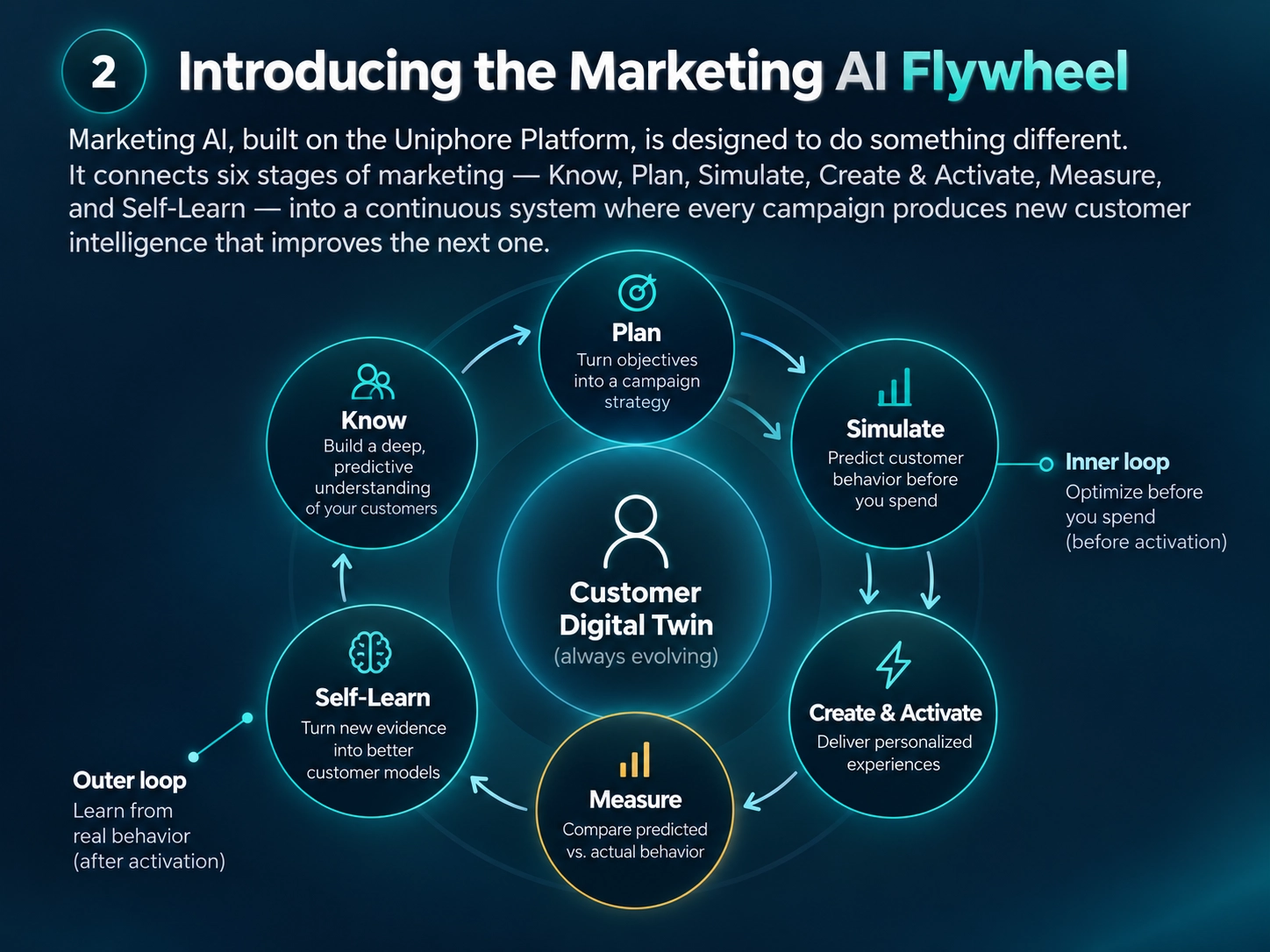
Marketing AI approaches that problem through a continuous system built around six stages: Know, Plan, Simulate, Create & Activate, Measure, and Self-Learn. But underneath those stages are two connected feedback loops. The first happens before activation, where Plan and Simulate form an inner optimization loop that lets marketers refine a campaign before it reaches customers. The second begins after activation, where Measure and Self-Learn form an outer learning loop that compares predicted behavior with what occurred and carries that evidence into the models informing the next campaign. The distinction is clear: the inner loop improves the campaign given what the current system knows about the customer, and the outer loop learns and improves what the system knows about the customer based on what occurred.
Loop 1: Optimize Before You Spend
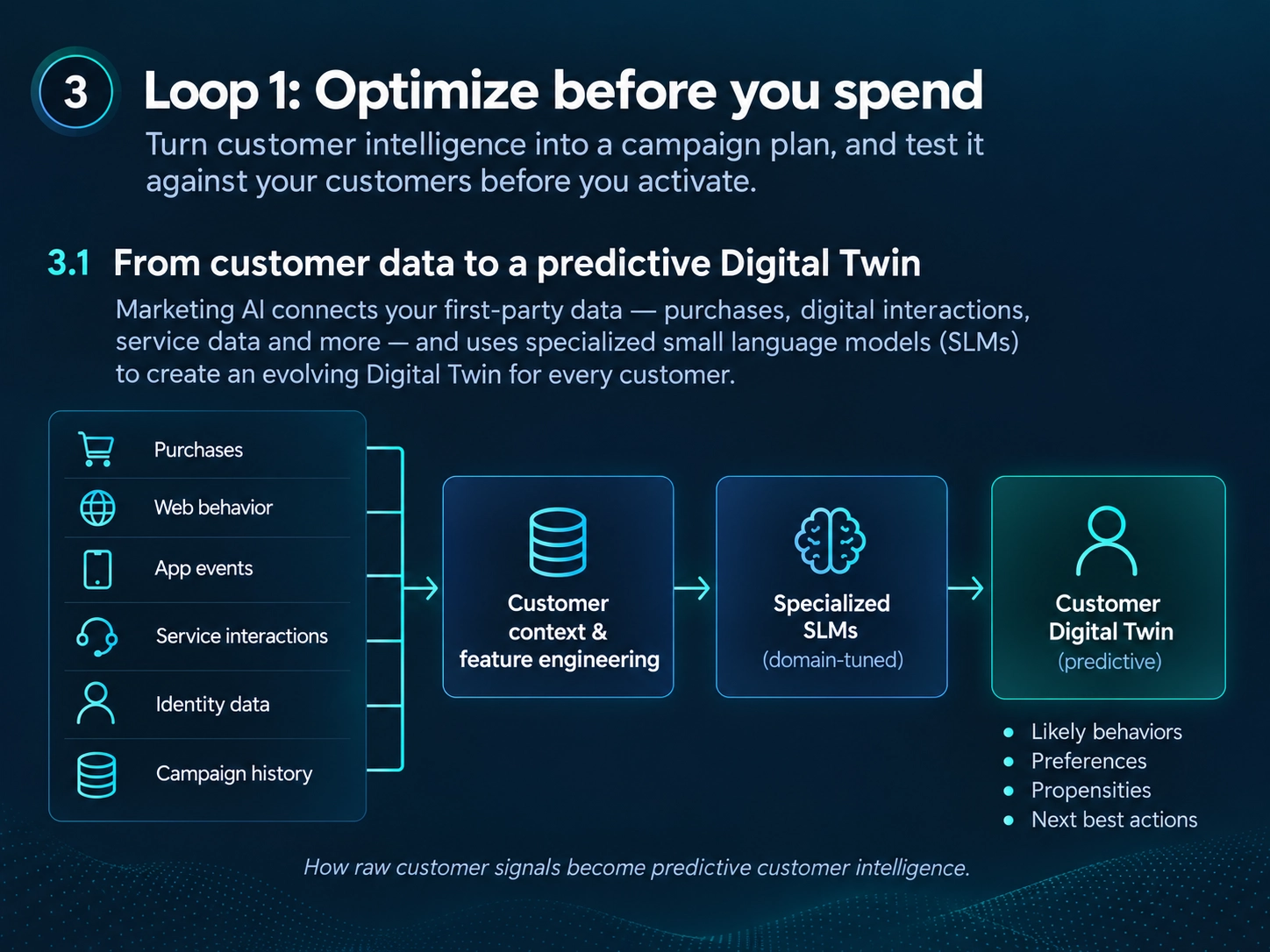
The Flywheel begins with the system knowing and understanding the customer, powered by the data and model infrastructure of Uniphore’s enterprise AI platform. Relevant signals can include first-party data such as purchases, digital interactions, and campaign responses, along with third-party identity and data sources. The objective is to understand the relationships within that data: how behaviors connect over time and how interactions across channels relate to each other.
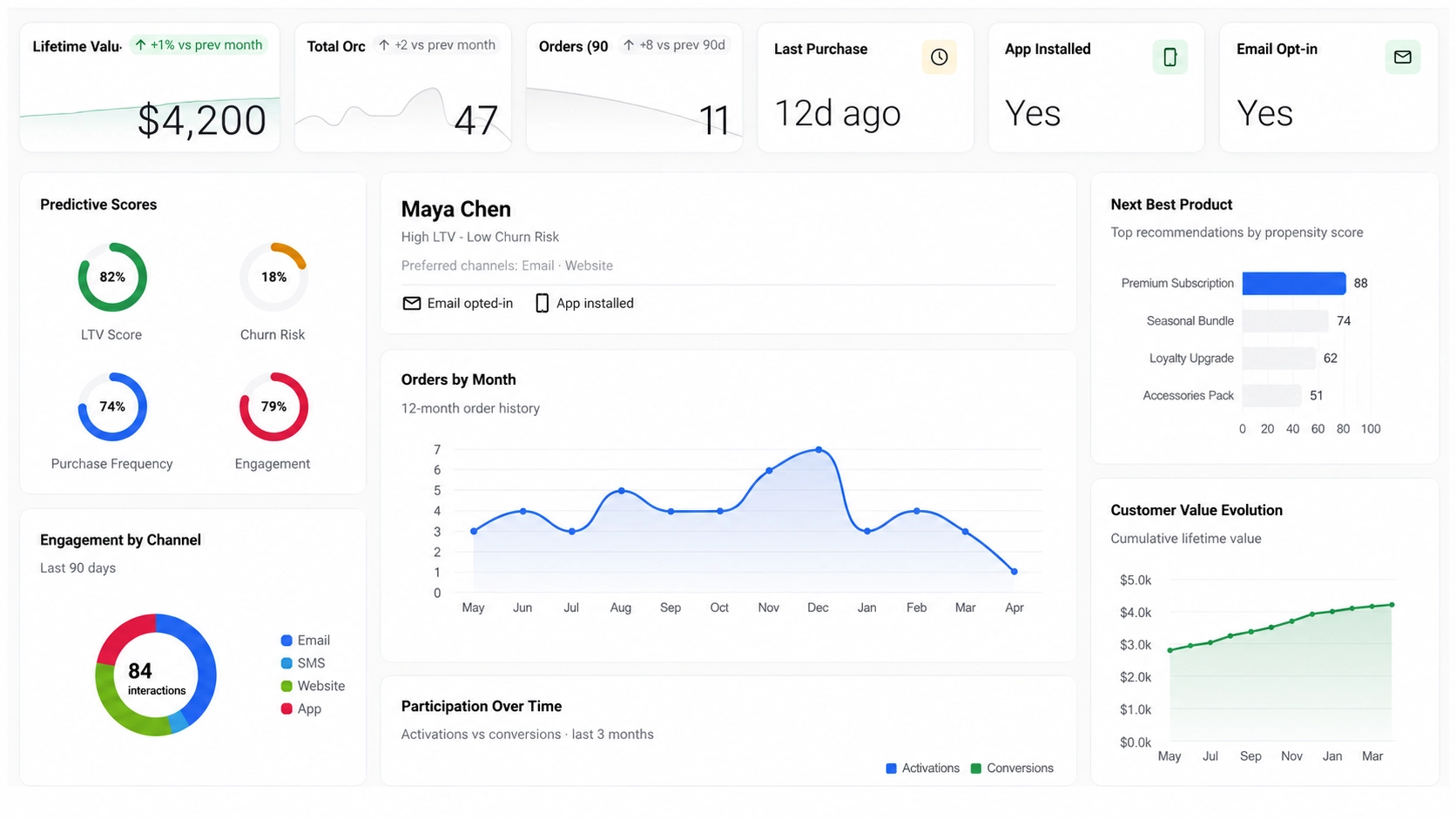
Once we have gathered that data, we can turn that context into customer intelligence through specialized small language models (SLMs). Within the platform, relevant enterprise data can be evaluated against available open-weight models to determine which is best suited to the domain and use case. The selected model can then be fine-tuned against the enterprise’s own data for greater domain accuracy. In Marketing AI, those specialized models are used to understand customer context and decision patterns: learning preferences, predicting likely events, and modeling customer behavior. At the individual level, that intelligence contributes towards the Digital Twin and as new preferences enter the system, it sharpens the model over time.
Turn a Business Objective into a Campaign Plan
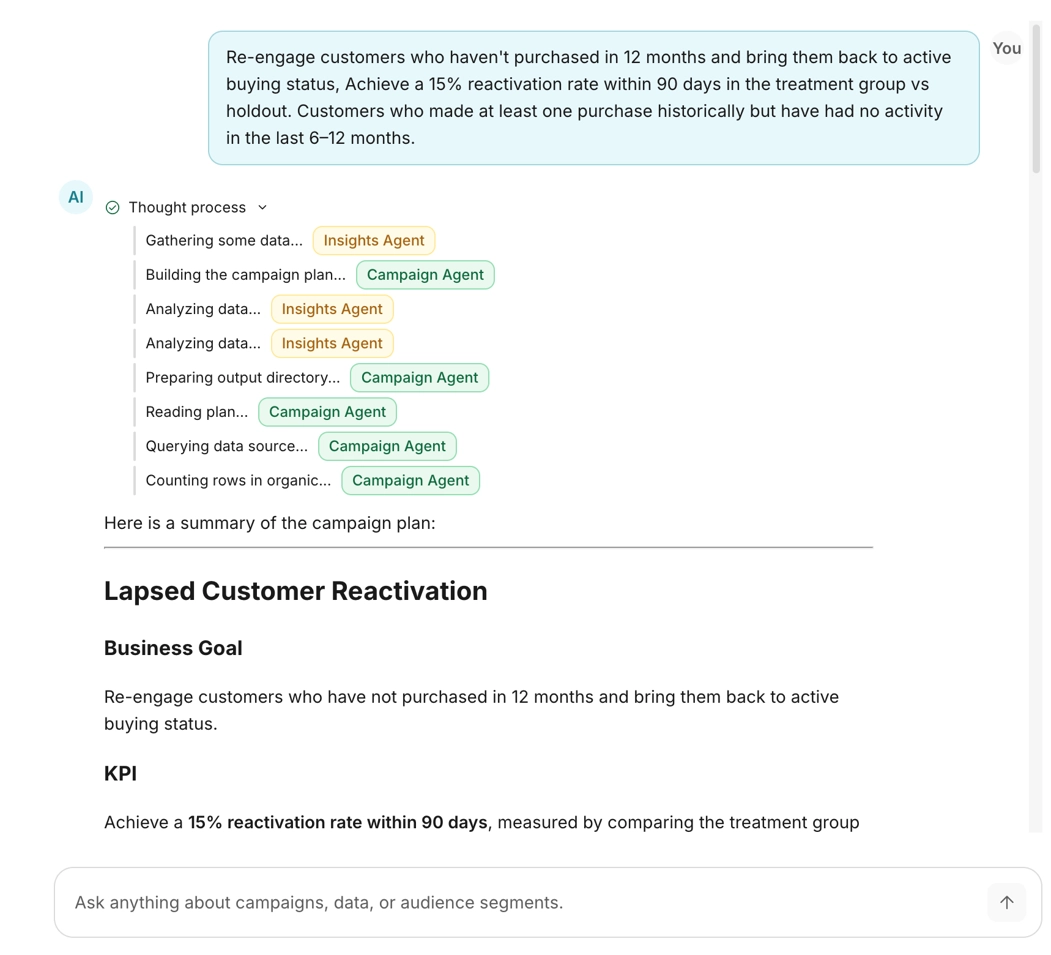
Once customer intelligence is established, the marketer begins with a business objective in natural language. Marketing AI does not simply pass that objective to a single model and ask it to generate a campaign. Instead, specialized agents gather the context required to construct the plan. The Insights Agent retrieves and analyzes relevant customer signals, audience characteristics, and prior campaign performance, establishing the evidence the plan should be grounded in. That context is then handed to the Campaign Agent, which translates the marketer’s objective and the gathered intelligence into a structured campaign strategy across the audience, journey, messaging, and channels. The marketer can provide additional context, including the business objective, target metrics, and timeline, while the agent can ask follow-up questions when additional information is required. The output of the Plan stage is a structured set of campaign parameters: audience, journey, messaging, channel mix, and budget allocation. Those parameters define the campaign that the Simulate stage will evaluate against the Digital Twins of the intended audience.
Simulate the Campaign Before Customers Experience It
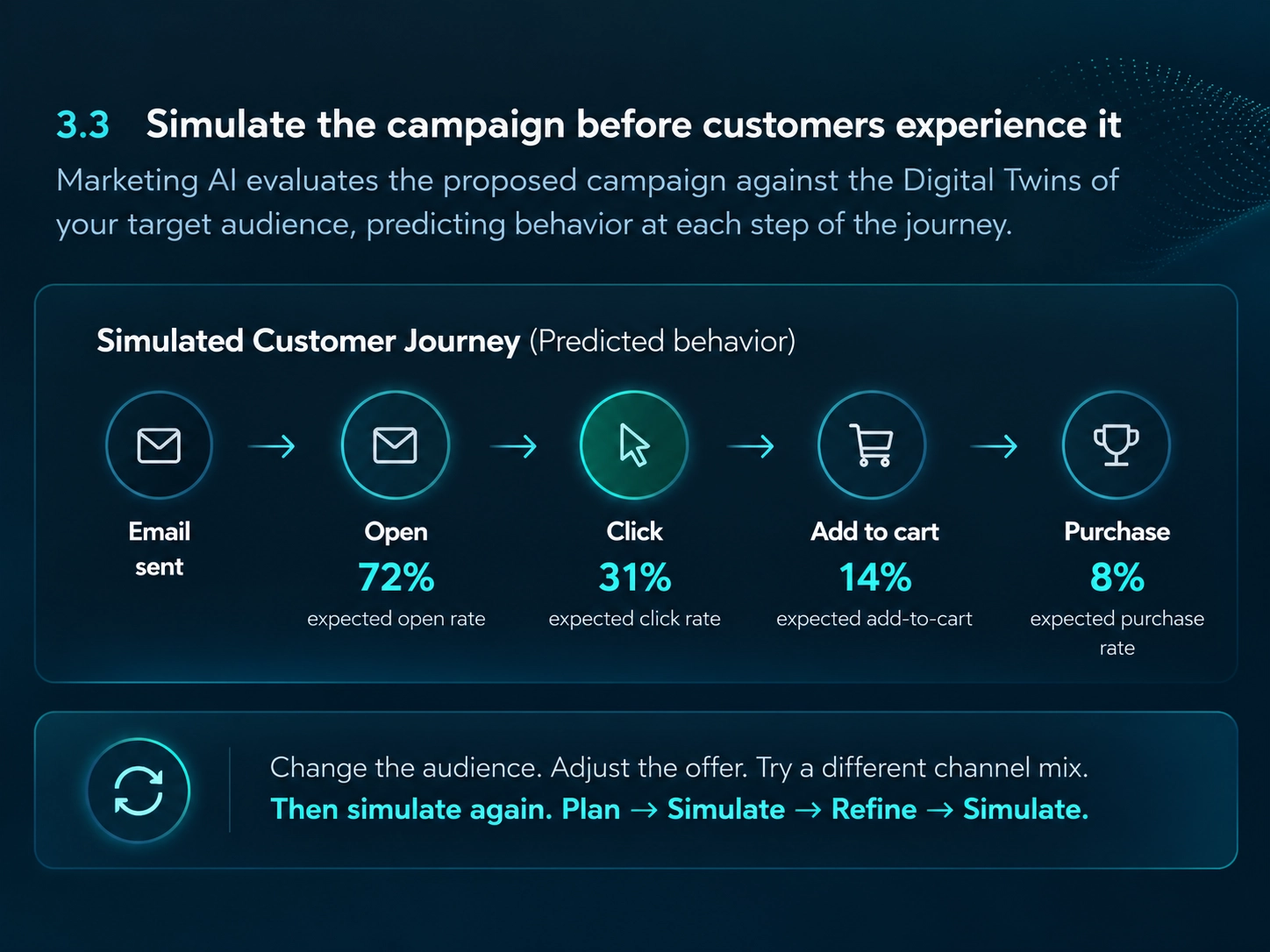
The structured campaign created in the Plan stage becomes the input to Simulate, where Marketing AI evaluates the strategy before it reaches the market. The proposed journey is simulated node by node against the Digital Twins of the intended audience, generating predicted outcomes across the journey rather than applying a single historical conversion rate to the campaign as a whole. Preserving the predictions is essential because the final campaign outcome itself can’t show how closely the model’s expectations aligned with customer behavior in the journey. By retaining predictions at the node level, we can create a more granular baseline as a point of comparison with observed behavior.
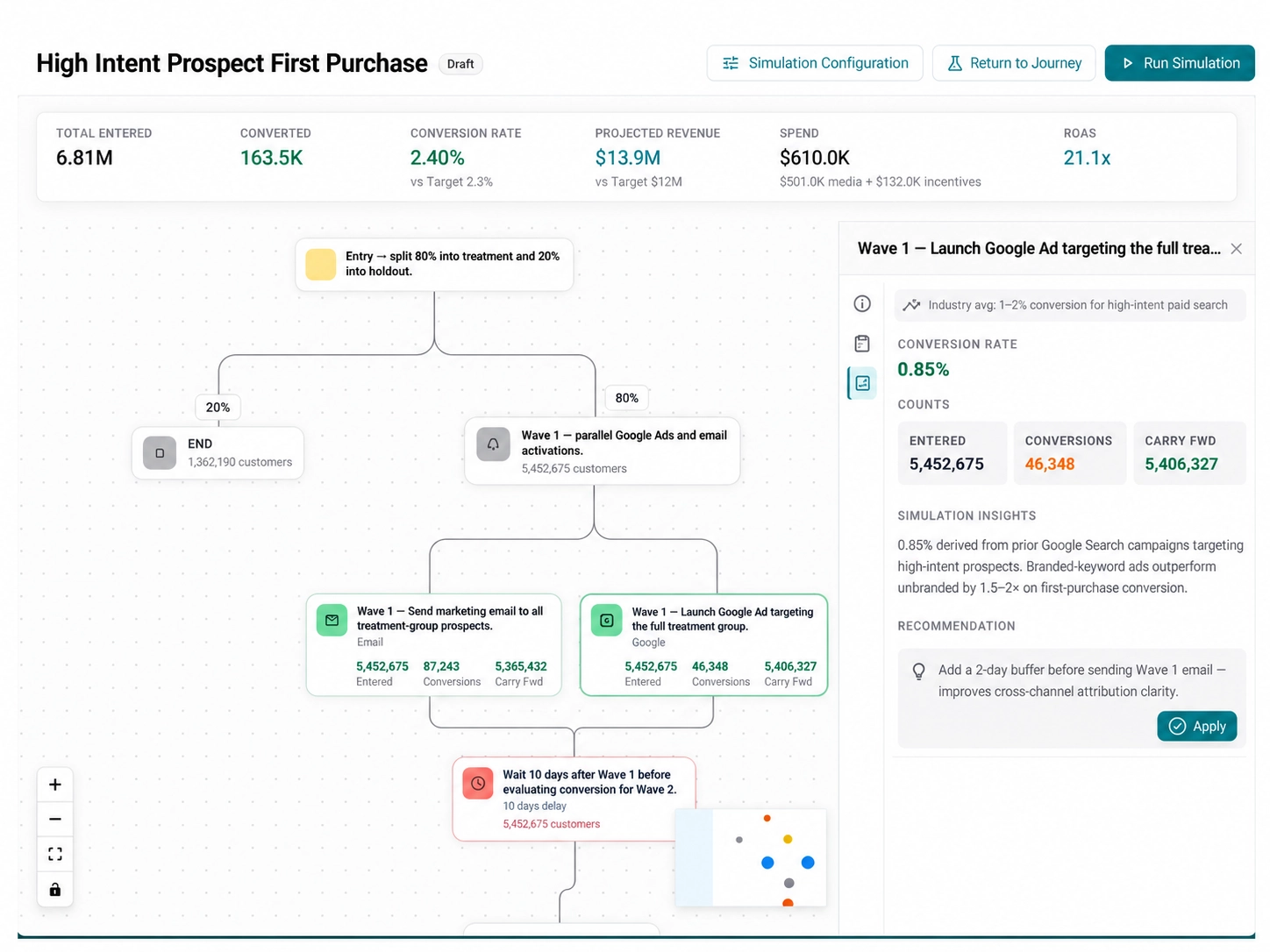
Audience splits, channel selections, messaging, timing, and other journey parameters can therefore be evaluated in the context of their predicted downstream outcomes. Those node-level predictions can still roll up into campaign-level measures such as projected conversion rate, revenue, spend, and ROAS.
The Inner Optimization Loop
Changing the audience definition, message, channel mix, timing, or other campaign parameters creates a new scenario that can be evaluated against the same customer intelligence. This creates an inner optimization loop: The Plan stage generates a candidate campaign configuration, the Simulate stage evaluates its expected behavior, and the results inform the next iteration of the plan. The marketer can then refine the campaign and simulate again before committing spend.
Repeating this process across millions of customers creates an inference challenge. Each scenario may require customer-level predictions across multiple journey nodes, and testing several campaign configurations increases the inference workload.
Running those evaluations with a general-purpose large language model (LLM) would require repeatedly supplying and processing substantial amounts of customer history and enterprise context. Marketing AI instead uses specialized SLMs that carry relevant customer and domain context in learned weights, reducing how much context must be reconstructed for each inference. Lower inference overhead translates into lower latency and compute requirements.
Loop 2: Learn After Customers Respond
Eventually, simulation has to meet reality. Once the marketer selects a campaign configuration, activation moves the strategy from a predicted state into execution. Marketing agents use the campaign definition and customer intelligence produced earlier in the Flywheel to activate personalized experiences across channels, including email and SMS. Architecturally, Marketing AI functions as the intelligence and decisioning layer across the existing execution stack, determining who should be targeted, through which channels, and under what conditions.
Autonomous execution remains bounded by marketer-defined controls. Budget thresholds, approval flows, and other policies establish guardrails around what agents can execute automatically and what should be surfaced for human review. For the Flywheel, activation brings the predicted journey to life because until this point each node had simply been a simulation. Once the campaign is executed, those same points in the journey begin producing real customer behavior, which becomes the ground truth for the Measure stage.
When Prediction Meets Reality
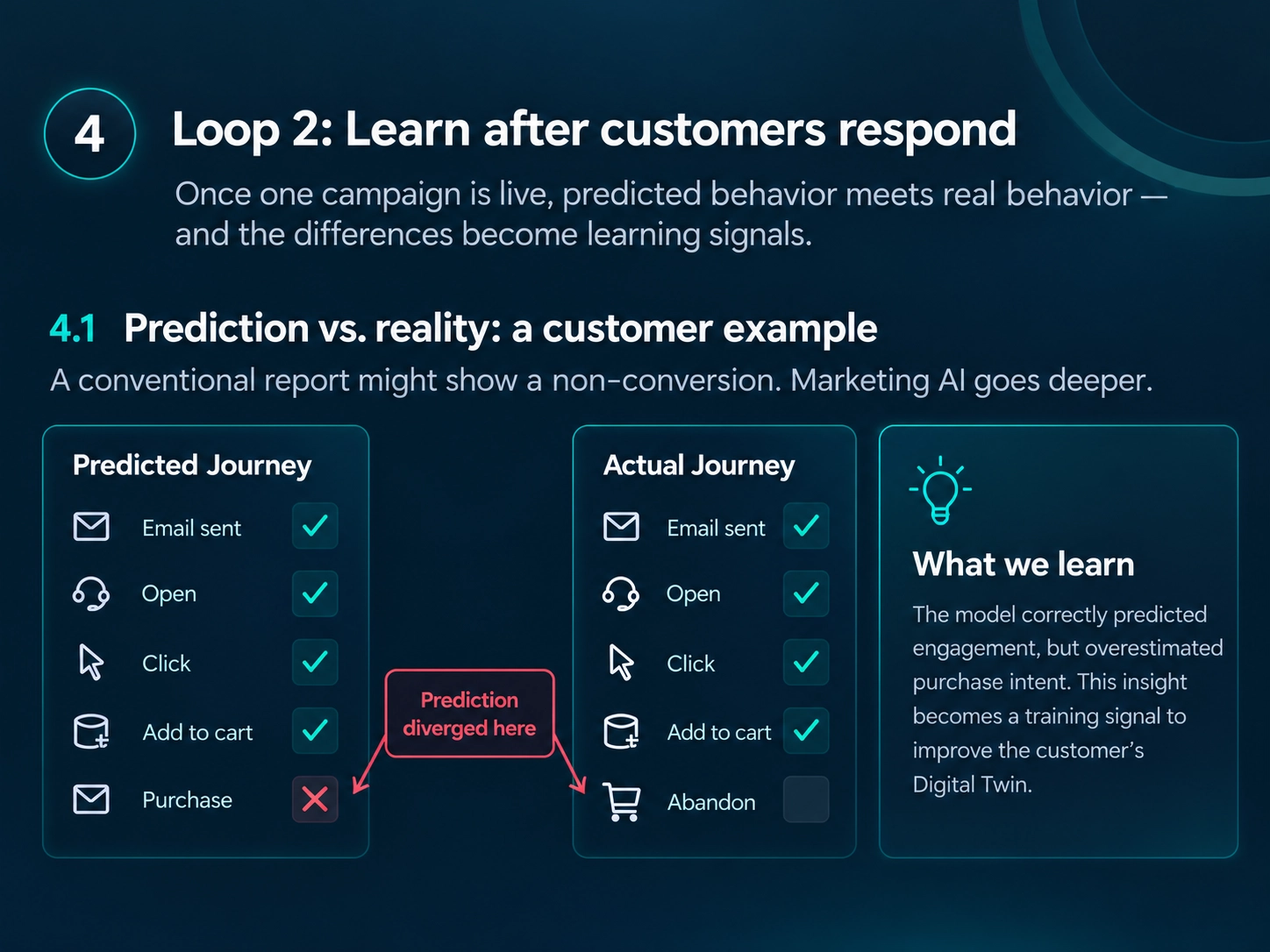
Once the campaign runs, the customer opens the email, clicks the offer, and adds the product to the cart as expected, yet fails to complete the purchase. At the campaign level, that customer appears simply as a non-conversion. At the node level, however, the model remained aligned with observed behavior through engagement and diverged only around the purchase decision. That point of divergence is a more informative learning signal than the final outcome alone.
Measurement Becomes Evidence, Not Just Reporting
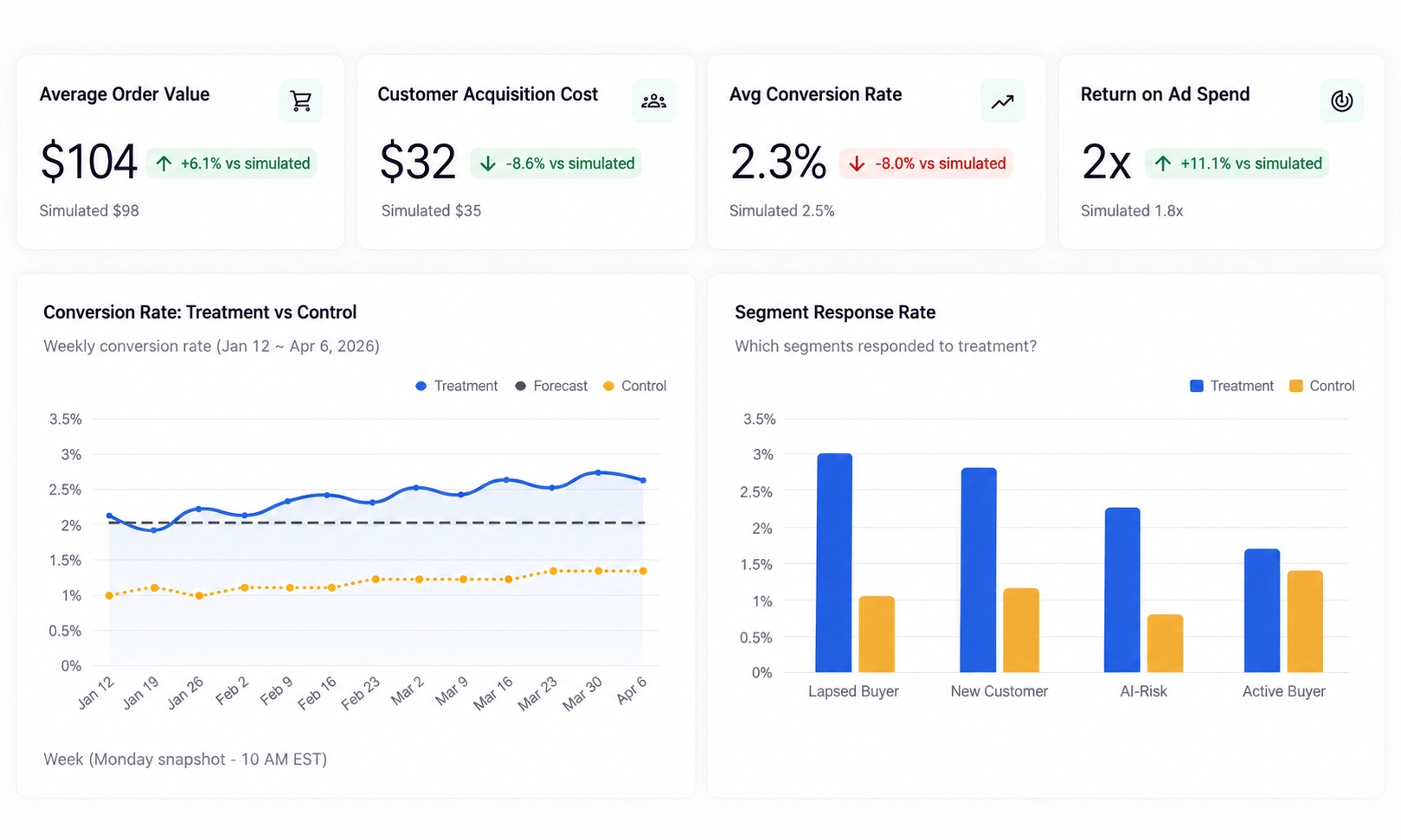
Once the campaign is running, the simulated journey becomes the reference point against which observed performance can be evaluated. At the campaign level, measures such as conversion rate, acquisition cost, revenue, and ROAS can be compared with the expectations established during simulation. More importantly, Marketing AI compares actual results with simulation predictions at each campaign node, creating a feedback signal that connects execution back to the models that generated the forecast. The difference between predicted and observed behavior becomes evidence that the Self-Learn stage can carry into future decisions.
Close the Learning Loop
The Self-Learn stage begins with the prediction versus observation deltas produced during the Measure stage. Because Marketing AI evaluates actual outcomes against simulated outcomes at the campaign-node level, the system retains not only whether a prediction was correct, but where observed behavior departed from the expected journey.
That difference becomes new behavioral evidence about the customer. In the earlier example, the system was aligned with the customer through engagement but diverged around the purchase decision. That evidence can be incorporated into the customer’s Digital Twin, refining its representation of the individual for subsequent predictions. As campaign outcomes accumulate, customer Digital Twins sharpen and simulation models retrain.
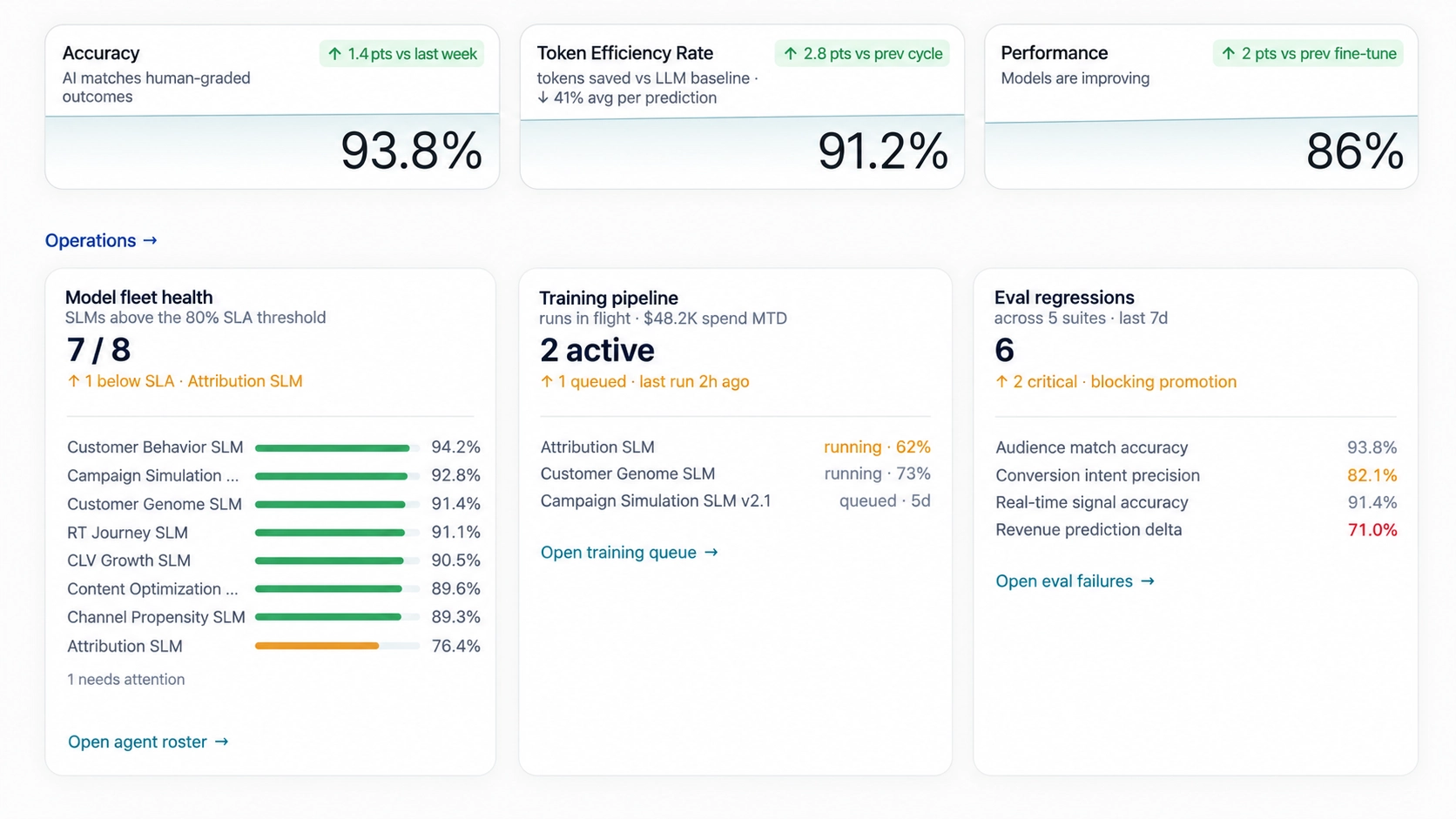
With Marketing AI being built on the Uniphore’s AI platform, that learning operates within a broader model evaluation and monitoring lifecycle. The platform provides visibility into training activity, model accuracy, evaluation regressions, drift alerts, and performance against defined SLA thresholds, allowing changes in model behavior to be observed across successive training cycles.
Self-Learning is much more than just the addition of behavioral evidence; it’s a cycle of model updates, evaluations, and monitoring.
Campaign N Changes What the System Knows Before Campaign N+1
Marketing has always operated in cycles: plan, execute, measure, repeat. At Uniphore, we intend to preserve that cycle. What we are changing, however, is what gets carried from one cycle into the next. The inner Plan –> Simulate loop helps the marketer improve a campaign before it reaches customers. The outer Measure –> Self-Learn loop uses what happened to improve the intelligence that future campaigns begin with. The campaign may have ended, but the evidence generated through it does not: Digital Twins sharpen, simulation models retrain, and the system carries that learning forward into the next decision. The result is a campaign lifecycle where each execution also becomes a learning event. Campaign N does not simply inform Campaign N+1; it changes the state of the system that Campaign N+1 begins from.
See Uniphore’s Marketing AI Flywheel in Action
Learn how each stage improves the system—and your campaign outcomes.
Frequently Asked Questions
Uniphore Marketing AI is an end-to-end, autonomous marketing system that plans, simulates, activates, and continuously learns from customer interactions. While traditional predictive marketing answers “What might happen?” using static propensity scores, Uniphore Marketing AI answers “What should we do, and what did we learn?” It acts as a continuous system of intelligence that executes campaigns and updates its underlying customer models based on observed outcomes.
The Uniphore Marketing AI Flywheel is a continuous six-stage operational framework—Know, Plan, Simulate, Create & Activate, Measure, and Self-Learn, built on two interconnected feedback loops:
– The Inner Loop (Pre-activation): Allows marketers to plan and simulate campaigns against virtual audiences to optimize performance before budget is spent.
– The Outer Loop (Post-activation): Captures real-world customer behavioral divergence to retrain models and update customer intelligence for future campaigns.
A Customer Digital Twin in Marketing AI is a dynamic, evolving model of an individual customer that helps predict how that customer is likely to behave and respond. Powered by first-party behavioral signals and specialized Small Language Models (SLMs), the Digital Twin models preferences, churn risk, customer lifetime value (CLV), channel propensities, and next-best actions. Marketing AI can then use these individual-level predictions to simulate how customers are likely to respond to different campaign scenarios before launch.
Marketing AI simulates a proposed campaign against the Digital Twins of the intended audience before the campaign goes live. It predicts behavior across the customer journey and rolls those predictions up into expected outcomes such as conversion, revenue, spend, and ROAS. Marketers can change the audience, message, channel mix, timing, or other campaign parameters, compare the expected impact, and simulate again before committing spend.
Marketing AI uses specialized SLMs to make customer-level prediction and campaign simulation faster and more cost-efficient at scale. Simulating multiple campaign scenarios across millions of customers can require predictions at multiple journey nodes, creating a significant inference workload. General-purpose LLMs may require substantial customer history and enterprise context to be supplied and processed repeatedly. Specialized SLMs encode relevant customer and domain patterns in their learned weights, reducing how much context must be reconstructed for each inference. This lowers inference overhead, latency, compute requirements, and ultimately the cost of running large-scale customer predictions and simulations.
In Marketing AI, planning is orchestrated through specialized agents rather than a single prompt:
– Insights Agent: Retrieves and analyzes first-party customer signals, segment trends, and historical campaign benchmarks to establish baseline evidence
– Campaign Agent: Ingests business goals in natural language and translates them, grounded by the Insights Agent’s data, into structured journey configurations, audience logic, and channel allocations.
Node-level divergence identifies exactly where a customer’s actual behavior differs from the behavior Marketing AI predicted during campaign simulation. Before activation, Marketing AI generates predictions across individual journey nodes, such as send → open → click → add to cart → purchase. Once the campaign runs, actual behavior can be compared with those predictions at the same points in the journey.
For example, a customer may open an email, click an offer, and add a product to cart as predicted, but abandon instead of purchasing. Looking only at the final outcome records a non-conversion. Node-level comparison shows that the prediction remained aligned through engagement and diverged specifically at the purchase decision. That difference becomes new behavioral evidence about the customer, providing a more precise signal that can be incorporated into the customer’s Digital Twin and inform subsequent predictions and simulations.
Marketing AI supports enterprise governance through marketer-defined controls and the model evaluation and monitoring capabilities of Uniphore’s AI platform. At the execution layer, budget thresholds, approval flows, and other policies define what agents can execute automatically and what should be surfaced for human review, keeping autonomous execution bounded by enterprise controls.
At the model layer, the platform provides visibility into the learning lifecycle, including training activity, model accuracy, evaluation regressions, drift alerts, and performance against defined SLA thresholds. As models are updated across learning cycles, these ModelOps capabilities make changes in model behavior observable and allow teams to identify degradation or unexpected performance before relying on updated models at scale. The Self-Learn stage therefore includes not only incorporating new behavioral evidence, but also model updates, evaluation, and ongoing monitoring.
Marketing AI learns by comparing predicted customer behavior with what actually happens at each stage of the campaign journey. These prediction-versus-observation differences become new behavioral evidence about the customer. That evidence can be incorporated into the customer’s Digital Twin to refine future predictions, while accumulated campaign outcomes can inform simulation model retraining. Through the Uniphore platform, model updates are then evaluated and monitored for accuracy, drift, regressions, and performance against defined thresholds. This closes the Flywheel’s learning loop, so each campaign can improve the intelligence that subsequent campaigns start with.
The inner loop improves the campaign before it runs; the outer loop improves the intelligence future campaigns start with. In the inner loop, Plan and Simulate work together so marketers can change campaign parameters, evaluate expected outcomes, and simulate again before committing spend. In the outer loop, Measure and Self-Learn compare predicted behavior with actual customer behavior and carry that evidence into the customer intelligence and models informing subsequent campaigns.