



Platform Comparison · 2026
Enterprise AI Solutions Compared
Enterprise AI leaders At A Glance
Uniphore is an enterprise AI platform built on a unified 4-layer architecture that connects data, knowledge, models, and AI agents in a single system.
In contrast, hyperscaler platforms like Google’s Gemini Enterprise Agent Platform (formerly Vertex AI), AWS Bedrock, and Microsoft Foundry provide powerful but fragmented services across these layers, requiring integration, orchestration, and engineering effort. Palantir provides a strong data and ontology foundation but is more data-centric and typically requires additional implementation to operationalize AI agents. Uniphore is designed to reduce complexity and accelerate time to value by delivering the full AI lifecycle in one platform.
| Platform | What it is | Best for | Key limitation |
|---|---|---|---|
| Uniphore | Integrated AI platform (data → knowledge → models → agents) | End-to-end AI automation | Less infra-level customization |
| Gemini Enterprise Agent Platform | Hyperscaler ML platform | Model development | Requires pipelines + ML expertise |
| AWS Bedrock | Hyperscaler model layer | Model access + customization | No native orchestration layer |
| Microsoft Foundry | Hyperscaler AI ecosystem | Enterprise AI services | Multi-product complexity |
| Palantir | Data + ontology platform | Data unification + operations | AI lifecycle not fully integrated |
A unified system vs. hyperscalers
The difference between Uniphore and its competitors is not just features – it’s how AI systems are built.

Uniphore:
Unified system
- Connects data → knowledge → models → agents
- Includes process discovery, model development, and agent orchestration
- Designed for business + IT ownership
AGENTS
Orchestration + execution
MODELS
Domain SLMs + foundation
KNOWLEDGE
Ontology + reasoning
Data
Zero-copy access

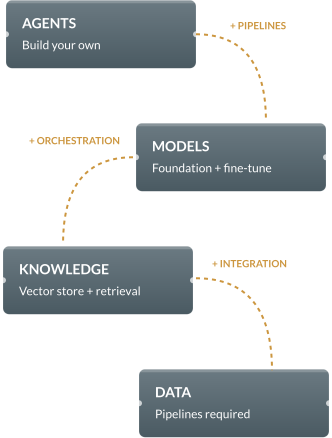
Hyperscalers:
Modular assembly
- Gemini Enterprise Agent Platform, AWS Bedrock, Microsoft Foundry
- Provide capabilities at each layer, but:
- Data lives in one system
- Models in another
- Agents/workflows in another
- Require:
- pipelines
- orchestration
- integration across services

Palantir:
Data-first platform
- Strong ontology and data modeling layer
- Enables operational applications
- Requires additional effort to:
- build and deploy AI models
- orchestrate agents end-to-end
AGENTS
Orchestration + execution
MODELS
Bring or build your own
KNOWLEDGE
Reasoning layer to add
DATA + ONTOLOGY
Strong unification and modeling layer
Operational applications ready
Key takeaway: Uniphore delivers a working AI system. Hyperscalers provide the components to build one
Enterprise AI platform comparison
| Category | Uniphore | Gemini Enterprise Agent Platform (Google) | AWS Bedrock | Microsoft Foundry | Palantir |
|---|---|---|---|---|---|
| AI lifecycle coverage | End-to-end (data → agents) | Model-centric | Model access | Multi-product | Data-centric |
| Architecture | Unified 4-layer system | Modular | Modular | Multi-product | Ontology-based |
| Data strategy | Zero-copy (no movement) | BigQuery pipelines | AWS pipelines | Fabric pipelines | Centralized ontology |
| Process discovery | Native | None | None | None | Limited/manual |
| Model discovery | Domain SLMs + built-in | Gemini + Model Garden | Multi-model APIs | GPT + multi-model | Model-agnostic |
| Agent development | Visual, no-code builder | Developer-led | Developer-led | Mixed | App/workflow-based |
| Governance | Built-in across layers | Configured | Configured | Split across tools | Strong governance |
| Time to value | Weeks | Months | Months | Months | Months |
Platform-by-platform comparison

Uniphore vs Gemini Enterprise Agent Platform
Gemini Enterprise Agent Platform is a hyperscaler machine learning platform designed for building and managing models, while Uniphore is an integrated AI platform designed for deploying AI agents and automating enterprise workflows. Gemini Enterprise Agent Platform requires data science expertise and pipeline orchestration, while Uniphore reduces the need for heavy engineering.

Uniphore vs AWS Bedrock
AWS Bedrock is a hyperscaler service that provides API access to foundation models, while Uniphore provides a complete platform for building, deploying, and managing AI agents. AWS Bedrock requires additional infrastructure and orchestration, while Uniphore includes these capabilities natively.

Uniphore vs Microsoft Foundry
Microsoft Foundyis a hyperscaler ecosystem combining services like Foundry, OpenAI, Fabric, and Copilot tools, while Uniphore delivers a unified platform with built-in data, models, and agent orchestration. Foundy requires integration across multiple services, while Uniphore minimizes that complexity.

Uniphore vs Palantir
Palantir provides a powerful data and ontology platform for operational applications, while Uniphore focuses on end-to-end AI deployment with integrated models and agents. Palantir often involves longer implementation cycles, while Uniphore emphasizes faster time to value.
Which enterprise AI platform is right for you?

Choose Uniphore if:
- You want faster time to value (weeks, not months)
- You need AI agents and workflows, not just models
- You want business teams involved in AI deployment
- You want to avoid hyperscaler integration complexity

Choose hyperscalers if:
(Gemini Enterprise Agent Platform, AWS Bedrock, Foundry)
- You have strong engineering or ML teams
- You want maximum customization and control
- You are already invested in a cloud ecosystem

Choose Palantir if:
- Your priority is data unification and ontology modeling
- You are comfortable with longer implementation cycles
- You need custom operational applications
Ready to move beyond hyperscaler complexity?
Explore detailed comparisons or see how Uniphore works in your environment.
FAQ
Uniphore differs from hyperscalers by offering a fully integrated AI platform, while hyperscalers provide separate services that must be combined. Hyperscalers prioritize flexibility and scale, while Uniphore prioritizes speed, usability, and end-to-end deployment.
Uniphore is designed for deploying AI agents and automating workflows, while Google’s Gemini Enterprise Agent Platform is designed for building and managing machine learning models. Gemini Enterprise Agent Platform requires data science expertise, while Uniphore enables broader business and IT usage.
Uniphore provides a complete AI platform with built-in orchestration and workflows, while AWS Bedrock provides API access to foundation models. Organizations using AWS Bedrock must build additional layers to operationalize AI.
Uniphore delivers a unified platform, while Microsoft Foundry consists of multiple services such as Foundry, OpenAI, Fabric, and Purview. Foundry requires integration across these tools, while Uniphore simplifies deployment.
Palantir focuses on data integration and ontology modeling, while Uniphore focuses on deploying AI agents and automating business processes. Uniphore typically offers faster time to value.
Hyperscalers are better for organizations that need deep customization, infrastructure control, and have strong engineering teams. Uniphore is better for organizations that want faster deployment, integrated capabilities, and business-led AI adoption.
The best platform depends on priorities. Uniphore is well-suited for rapid, integrated AI deployment, while hyperscalers are better suited for custom-built AI systems and infrastructure-heavy approaches.
Ready to move beyond hyperscaler complexity?
Explore detailed comparisons or see how Uniphore works in your environment.