
Composable AI
Key Takeaways for Tech Leaders (TL;DR)
Composable AI is an architectural approach that lets enterprises mix and match AI models, data sources, knowledge systems, and AI agents without being locked into a single vendor stack. By separating applications from underlying infrastructure and supporting flexible integration patterns, including zero-copy access where appropriate, composable AI can lower costs, speed time-to-value, help meet data sovereignty requirements, and move AI from pilots to production at scale.
What Is Composable AI?
Composable AI is an enterprise AI architecture that helps businesses assemble AI from modular components — like data warehouses, models, and agents — with flexibility and without tightly coupling them to a single vendor, cloud, or infrastructure stack.
Instead of building AI as a monolithic system, composable AI helps enterprises:
- Use any AI model (open or proprietary)
- Access live enterprise data without duplicating or migrating it
- Deploy AI agents across business workflows
- Swap or upgrade components without re-platforming
Composability gives us modular, interoperable components that can be assembled and reassembled as technology evolves.
As enterprises struggle to scale AI beyond pilots due to infrastructure, governance, and data constraints, they are increasingly shifting toward composable and sovereign AI architectures to overcome infrastructure bottlenecks.
Why Composable AI Matters Now
Despite billions invested in generative AI, most enterprises struggle to scale beyond pilots. According to an MIT Technology Report, only 5% of integrated pilots deliver measurable business value.
But the bottleneck is not the models themselves. The challenges are:
- Fragmented enterprise data
- Rigid integrations
- Vendor lock-in
- Security and compliance constraints
- Infrastructure not designed for rapidly evolving AI models
Composable AI directly addresses these issues by enabling:
- Zero-copy data access
- Model-agnostic orchestration
- Multi-cloud and on-prem deployment
- Modular agentic workflows
IDC expects 75% of global businesses to adopt composable architectures by 2027.
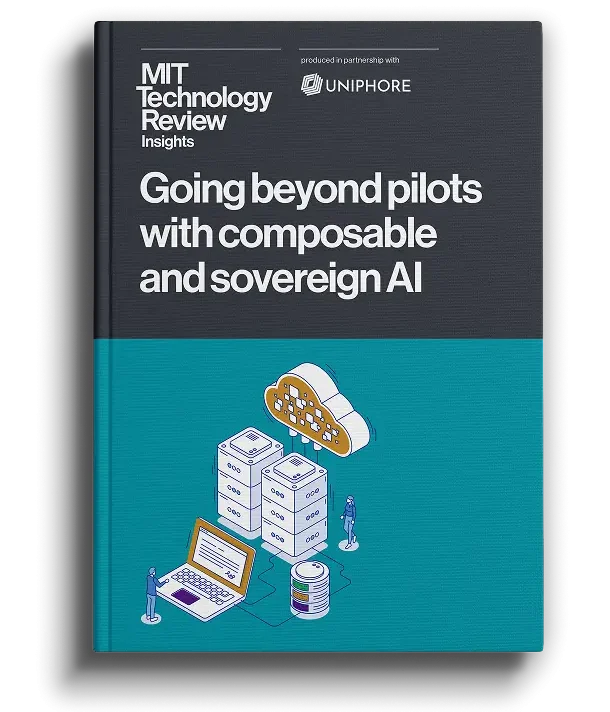
MIT Technology Review Insights
Going beyond pilots with composable and sovereign AI
Today marks an inflection point for enterprise AI adoption. Despite billions invested in generative AI, only 5% of integrated pilots deliver measurable business value and nearly one in two companies abandons AI initiatives before reaching production.
Core Principles of Composable AI

Zero-Copy Data Architecture
Composable AI minimizes unnecessary data movement and eliminates the need for duplicating data across systems. Instead of copying data into separate AI tools, systems query data in-place, inside warehouses such as Snowflake, Databricks, BigQuery, or Redshift. Composable systems enable no-copy integration and warehouse-native processing.
Key characteristics:
- Direct query access to live data
- Warehouse-native computation
- Unified governance
- Real-time insights
- Reduced storage and ETL costs
Business Impact:
- Faster deployment
- Lower infrastructure complexity and costs
- Stronger compliance and security posture

Model Agnosticism
AI models evolve constantly, so enterprises that hardwire applications to just one model risk re-engineering and not operating on the best model for their business or use case.
Composable AI introduces a model abstraction layer, allowing enterprises to stay nimble and:
- Use GPT, Claude, Gemini, Mistral, or proprietary models
- Swap models without major application rewrites
- Deploy fine-tuned Small Language Models (SLMs) for domain-specific use cases
- Optimize cost by matching model complexity to task complexity
This avoids what industry leaders call the “vertical integration trap” where everything is built around one provider, and enterprises don’t have the flexibility they need to adapt fast.

Modular Agentic Workflows
Composable AI extends beyond models into agentic systems. It allows enterprises to:
- Deploy or integrate pre-built AI agents (e.g., customer service, marketing, sales, HR)
- Build custom agents with low-code or pro-code tools
- Orchestrate multiple agents across workflows
- Apply guardrails, monitoring, and rollback mechanisms
This modularity enables AI to integrate directly into operational workflows, which is where ROI is actually realized.

Data Sovereignty
For many enterprises, especially in regulated industries, AI adoption isn’t just about capability—it’s about control.
Sovereign AI ensures organizations retain ownership of their data, models, and outputs, and that these assets remain within required geographic and regulatory boundaries.
This is critical for industries such as financial services, healthcare, telecom, and the public sector, where data residency, privacy, and auditability are non-negotiable.
Composable architectures can support these requirements by minimizing data movement and enabling flexible deployment across cloud, on-prem, or hybrid environments.
Composable AI vs. Traditional AI Architectures
| Traditional AI | Composable AI |
|---|---|
| Monolithic platforms | Modular architecture |
| Heavy data movement (ETL) | Zero-copy data access |
| Vendor lock-in | Model-agnostic |
| Rigid cloud dependency | Multi-cloud & on-prem flexibility |
| Long deployment cycles | Faster time-to-value |
| Pilot purgatory | Production-ready scalability |
Composable AI separates applications from infrastructure, often lowering costs as well as ensuring flexibility and long-term adaptability for the enterprise.
Architecture of a Composable AI Platform
Most enterprises are unprepared for AI. Data is spread across dozens of systems, critical knowledge is trapped in disparate formats, and legacy infrastructure was never designed to support AI workloads. Before any AI can deliver value, organizations need a data foundation that is flexible, accessible, and AI-ready — without requiring a full infrastructure overhaul.
A composable Data Layer addresses this by creating a seamless data fabric across any platform, application, or cloud. Rather than centralizing or migrating data, it preserves data sovereignty by querying and preparing data where it already resides — eliminating costly migrations and accelerating time to value.
- Composable data fabric
- Zero-copy architecture
- Structured + unstructured data support
- Hybrid/multi-cloud compatibility
In practice, this means the data layer of a composable AI architecture is made up of modular, interoperable components — each handling a distinct function, and each replaceable without disrupting the rest of the stack:
- Data Agents: Uniphore Data Agents are specialized AI agents that automate the hardest, most repetitive work in data engineering so teams can turn fragmented structured and unstructured enterprise data into governed, AI-usable assets for agents, models, and knowledge layers.
- Data Fabric: A unified connectivity layer that bridges structured and unstructured data from all enterprise sources — regardless of where they live.
- Data Acceleration: Ensures low-latency access and real-time performance so AI workloads aren’t bottlenecked by slow data retrieval.
- Data Transformation: Prepares and harmonizes data for downstream consumption by models, knowledge layers, and agents.
- Data Automation: Automates discovery, pipeline delivery, and governed insights to turn fragmented data into trusted, AI-usable assets.
Together, these components form the base of a composable AI architecture — one where the data layer can flex and scale independently, integrate with any model or application above it, and connect to any infrastructure below it.
The Big Book of Data Readiness for AI
Your definitive guide to AI-ready data architecture, governance, and culture.
Business Benefits of Composable AI
Faster Time to Value
Pre-built agents and zero-copy integrations help teams deploy quickly—so you can start seeing results without long implementation cycles.
Lower Total Cost of Ownership
Avoid unnecessary data duplication, choose the right models for each use case, and skip expensive migrations that slow innovation.
Future-Proof Infrastructure
Composable systems let you upgrade individual components as technology evolves—without rebuilding your entire architecture.
Reduced Vendor Lock-In
Stay nimble and use the tools that matter most when you need them, whether they’re cloud providers, data platforms, AI models, or orchestration engines.
Stronger Security and Compliance
Sovereign architectures support stronger governance by enabling guardrails, lineage tracking, and auditability — capabilities many AI pilots lack.
AI Is Moving Fast — Your Architecture Should Too
The AI ecosystem is evolving at an incredibly fast pace. That means AI strategies can’t rely on predicting what technology will look like years from now. Instead, enterprises need architecture built to adapt quickly as things change.
Composable AI isn’t just a technical concept—it’s an operational strategy. It gives organizations the flexibility to:
- Experiment safely
- Scale with confidence
- Govern AI responsibly
- Continuously adapt as technology evolves
Without this kind of flexibility, AI initiatives can quickly become fragile, expensive, or outdated (or all three).
Ready to Deploy Composable AI at Scale?
Uniphore’s platform is Composable – By separating applications & agents from underlying dependencies, Uniphore’s AI platform was designed from the ground up to be open, flexible, and composable, ensuring enterprises can deploy AI without being locked into a single model, vendor, or architecture.
Unlike Data Platforms that force rigid data architectures or Emerging AI Vendors that focus on narrow use cases with low extensibility, Uniphore enables organizations to leverage existing infrastructure, integrate with any AI model, and orchestrate AI-powered workflows seamlessly across business applications.
Composability allows for the assembly of best-of-breed components to create a system tailored to your unique needs. In data, composability is defined as separating the applications from the data storage and compute.
This is critical in AI since the provider you use for data storage and compute – like Snowflake, Google Cloud – might be different from the provider you use for AI models – like OpenAI, Anthropic, Databricks. Uniphore embraces this openness and has built an AI platform designed for this composable world. We believe the fastest and most practical way to help enterprises deploy is through Composable AI.
Our platform embraces Composable AI, allowing enterprises to:
- Integrate with any data source, model or agentic application (Snowflake, Google Cloud, on-prem solutions) without costly migrations.
- Deploy any AI model (GPT, Claude, Gemini, Mistral, LLaMA) while abstracting away complexity.
- Automate and execute AI-driven workflows across multiple business functions with a business-friendly interface.
If you want to understand how composable and sovereign AI can help your enterprise move beyond pilots and into production
Download our Guide: “The Big Book of Data Readiness”
Frequently Asked Questions (FAQ) About Composable AI
Composable AI is a modular approach to enterprise AI that lets organizations mix and match models, data sources, and agents without vendor lock-in or data duplication.
Traditional AI platforms are monolithic and tightly coupled. Composable AI separates layers—data, knowledge, models, and agents—so components can evolve independently from each other.
Composable AI builds on composable architecture principles—such as zero-copy data integration and modular systems—but applies them specifically to AI workloads.
It eliminates unnecessary data movement and duplication, prevents costly migrations, enables right-sized model usage, and avoids overbuilding with large language models.
Sovereign AI ensures enterprises retain ownership of their data and AI assets. Composable architectures support sovereign AI by allowing deployment across multi-cloud and on-prem environments without centralization.
Large enterprises with:
• Multi-cloud infrastructure
• Strict regulatory requirements
• Complex data environments
• High-volume operational workflows
While especially valuable for global enterprises, mid-sized organizations with modern cloud data warehouses also benefit from zero-copy and model-agnostic AI architectures.