

Every CIO faces the same question: are we getting full business value from the technology we already pay for? At Uniphore, we built an answer.
SpendIQ is an AI-first Spend & Usage Management application, developed internally, that gives business and technology leaders a clear view of where money is being spent, how applications are being actually used, and where savings are hiding. The idea is simple: connect the siloed and fragmented data we already have, apply AI to make sense of it, and turn that intelligence into action. To illustrate the potential scale of the opportunity, a representative enterprise portfolio could show $24.6M in tracked spend, $4.8M in potential spend leakage, and more than $7.5M in potential savings.
The business problem: spending is visible, value is not
Most enterprises know what they spend in total. The harder question is whether that spend aligns with real business demand. The challenge isn’t a lack of data; it’s fragmentation across systems. For example, contracts might live in SharePoint, workforce data in Workday, identity signals in Microsoft Entra ID, and usage data across Salesforce, Tableau, Freshservice, and dozens of individual applications.
SpendIQ connects these sources so leaders don’t have to reconcile the story manually and can finally answer:
- What are we spending and where?
- How much of what we purchased is being used?
- Where are we over-provisioned or paying for duplicate capability?
- Which renewals should we renegotiate, resize, or challenge?
- Where is there a credible savings opportunity?
At enterprise scale, these aren’t reporting questions—they are capital allocation questions. SpendIQ is designed to make the answers visible, explainable, and actionable.
One trusted view of spend, usage, and business demand
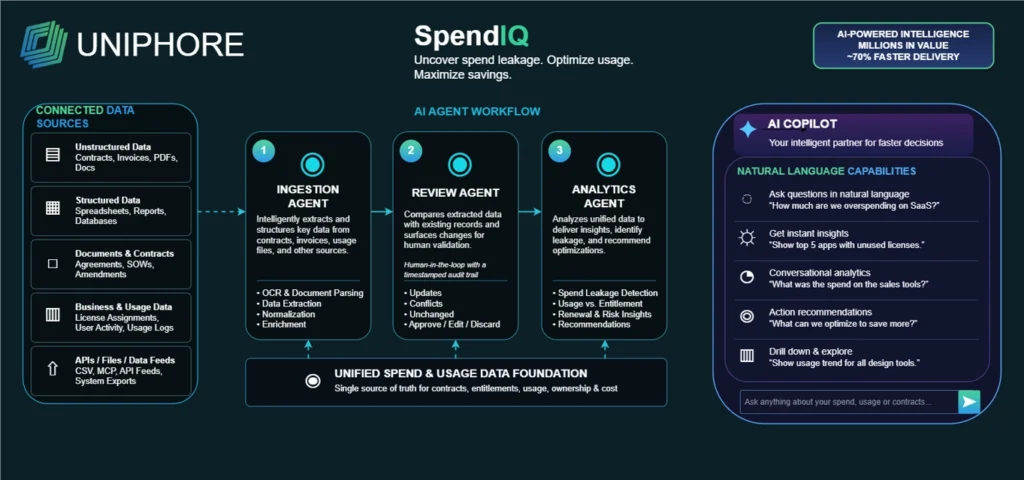
SpendIQ combines unstructured and siloed data sources, such as contracts, invoices, agreements, and SOWs with structured data from HR, finance and sales systems, identity providers, ITSM, reporting, spreadsheets, APIs, and usage feeds and more. Together, they create a Unified Spend & Usage Data Foundation that connects commercial terms, entitlements, ownership, intended user populations, actual users, utilization, and cost.
That context matters: optimization can’t be based on license counts alone. A sound decision has to weigh what was contracted, who the application was meant to serve, what was actually purchased, who is actively using it, and what obligations exist at renewal.
Three AI agents do the heavy lifting
Behind the experience are three specialized, fine-tuned AI agents. The technology matters, but the business outcome matters more: less manual reconciliation, stronger governance, and faster decisions.

Ingestion Agent – builds the fact base
Reads contracts, invoices, usage files, and connected system data, then extracts key terms: contract value, renewal dates, license commitments, purchased quantities, ownership. It replaces manual data entry with a consistent, AI-generated fact base and lineage.

Review Agent – keeps humans in control
Compares newly extracted information against existing records and flags updates, conflicts, or unchanged data for human validation before it becomes trusted. This human-in-the-loop approach gives us AI speed without giving up governance, accountability, or auditability.

Analytics Agent – finds the optimization opportunity
Weighs the same factors a business leader would: contract terms, renewal obligations, minimum commitments, intended users, licenses purchased and assigned, active usage, application scope, cost, and overlapping capabilities. It surfaces unused licenses, over-provisioning, duplicate tools, and renewal risk and recommends right-sizing, reallocating, consolidating, or renegotiating.
Now, just ask SpendIQ
The SpendIQ AI Co-Pilot puts that intelligence into plain language. Instead of opening dashboards, filtering reports, and exporting spreadsheets, a business leader can simply ask:
- “Show me the applications with the largest unused license value.”
- “Where can we reduce spend before the next renewal cycle?”
- “Which Sales tools have low adoption or overlapping capabilities?”
- “Which company-wide applications are over-provisioned based on active usage?”
Because the co-pilot is grounded in the same unified data foundation, it doesn’t just answer, it explains the drivers behind the answer.
From spending insights to measurable, multi-million-dollar savings
Unused licenses, oversized commitments, duplicate applications, low adoption, and unmanaged renewals are the most common sources of spend leakage. Evaluated together, AI can surface opportunities that traditional, point-in-time reporting misses.
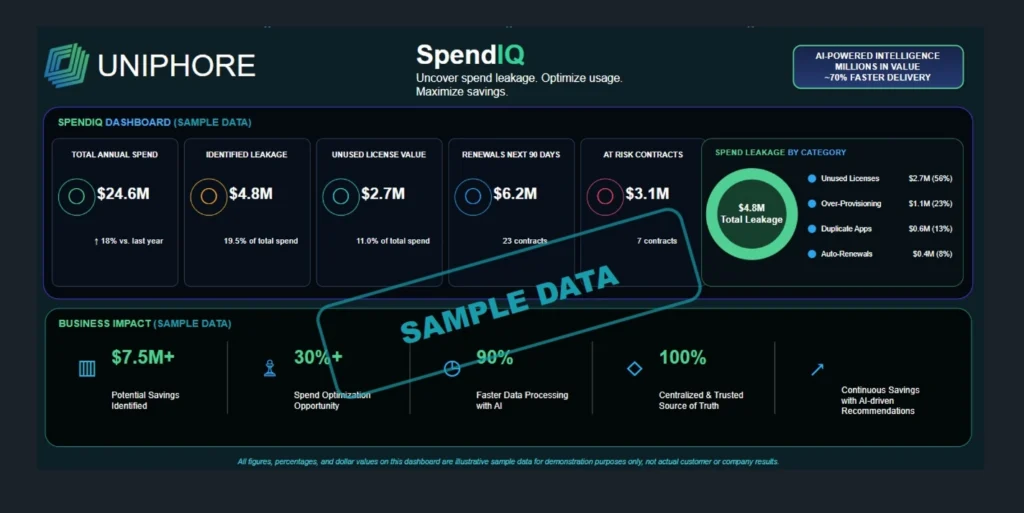
By connecting spend, contracts, entitlements, intended demand, active usage, and renewal obligations, SpendIQ can continuously flag where technology investments aren’t delivering expected value, creating the potential for multi-million-dollar savings across a large enterprise portfolio. More importantly, it builds a repeatable discipline: catch leakage early, understand the business context, act before renewal, and optimize continuously rather than waiting for an annual cost-cutting exercise.
70% faster: a preview of what AI changes for IT economics
Beyond spend optimization, SpendIQ demonstrates how an AI-first mindset can fundamentally reshape the IT operating model. By reducing delivery timelines by roughly 70%, teams can move from idea to working solution in weeks rather than months, validate business value earlier, iterate faster, and solve targeted business problems with leaner teams.
This represents a meaningful shift in how IT creates value. Instead of relying on large projects, lengthy requirements cycles, and significant upfront investment, an AI-first model starts with the business problem, rapidly building and testing solutions, measuring outcomes, and scaling what works.
The CIO agenda: from technology operator to business value creator
The mandate for enterprise IT is expanding. Operating secure, reliable technology remains foundational, but it is no longer the whole job. IT sits at the intersection of business processes, applications, data, integrations, security, and architecture. AI gives CIOs new leverage across that landscape, enabling teams to solve business problems faster and connect technology decisions more directly to financial and operational outcomes.
The broader opportunity is to apply an AI-first mindset across IT, using AI not simply as another technology capability, but as a force multiplier for productivity, speed, innovation, and measurable business value. SpendIQ is one example of that shift.
For business leaders, the takeaway is simple: the value of AI is not measured by the number of agents or models deployed, but by the business outcomes they enable.
Uniphore on Uniphore
SpendIQ is part of a broader discipline we call Uniphore on Uniphore: applying the same AI-first thinking we bring to customers to how we run our own company. The pattern is consistent: connect enterprise data, establish a trusted foundation, use AI agents to automate and analyze the work, keep humans in the loop where judgment and governance matter, and make the resulting intelligence accessible through natural language.
That’s the standard we hold AI to—not more automation for its own sake, but better economics and better business outcomes.
The result: spend smarter, act faster, and create measurable value.